B2B SaaS Conversion Rate in 2026: Benchmarks & How to Improve
Summarize this blog with AI:
What Is a Good B2B SaaS Conversion Rate in 2026? Benchmarks, Factors & How to Improve It
If your SaaS website gets 10,000 visitors a month, how many should become leads?
There isn’t a single number that answers that question.
A conversion rate that looks weak for a high-intent landing page might be perfectly reasonable for a broad content page. A self-serve SaaS product can also have a very different conversion rate from an enterprise platform with a six-month buying cycle.
The bigger problem is that “SaaS conversion rate” can mean several different things.
Are you measuring:
- Website visitors → leads?
- Landing-page visitors → signups?
- Visitors → free trials?
- Demos → opportunities?
- Free trials → paid customers?
These are different conversion events, so comparing them to one benchmark can lead you to the wrong conclusion.
This guide breaks down B2B SaaS conversion rate benchmarks for 2026, explains what affects SaaS conversion rates, and shows how landing-page optimization can help you turn more of your existing traffic into meaningful actions.
Table of contents
- What is a good B2B SaaS conversion rate?
- B2B SaaS conversion rate benchmarks for 2026
- SaaS landing page conversion rate vs. website conversion rate
- What counts as a conversion in B2B SaaS?
- B2B SaaS conversion rates by funnel stage
- What affects SaaS conversion rates?
- How traffic source changes conversion rates
- Why SaaS landing pages convert differently
- Homepage vs. landing page for SaaS
- 9 ways to improve your SaaS conversion rate
- The conversion gap: more leads without more traffic
- Why creating more landing pages becomes a bottleneck
- How Vounce helps SaaS teams create and optimize landing pages
- Final takeaway
- FAQs
What is a good B2B SaaS conversion rate?
A good B2B SaaS conversion rate depends on what you’re measuring, who you’re targeting, and where your visitors come from.
For example, a visitor reading a blog post about SaaS marketing isn’t necessarily ready to request a demo.
Someone searching for:
“B2B SaaS landing page builder”
has much stronger commercial intent.
Sending both visitors to the same page and expecting the same conversion rate doesn’t make much sense.
Your conversion rate can also change based on:
- Traffic source
- Search intent
- Industry
- Pricing
- Offer
- Sales cycle
- Buyer persona
- Landing-page experience
- Brand awareness
- Conversion event
So instead of asking:
“Is a 3% conversion rate good?”
Ask:
“Is 3% good for this page, this audience, this traffic source, and this conversion goal?”
That’s a much more useful benchmark.
B2B SaaS conversion rate benchmarks for 2026
There isn’t one universally accepted 2026 B2B SaaS conversion rate benchmark because different studies measure different things.
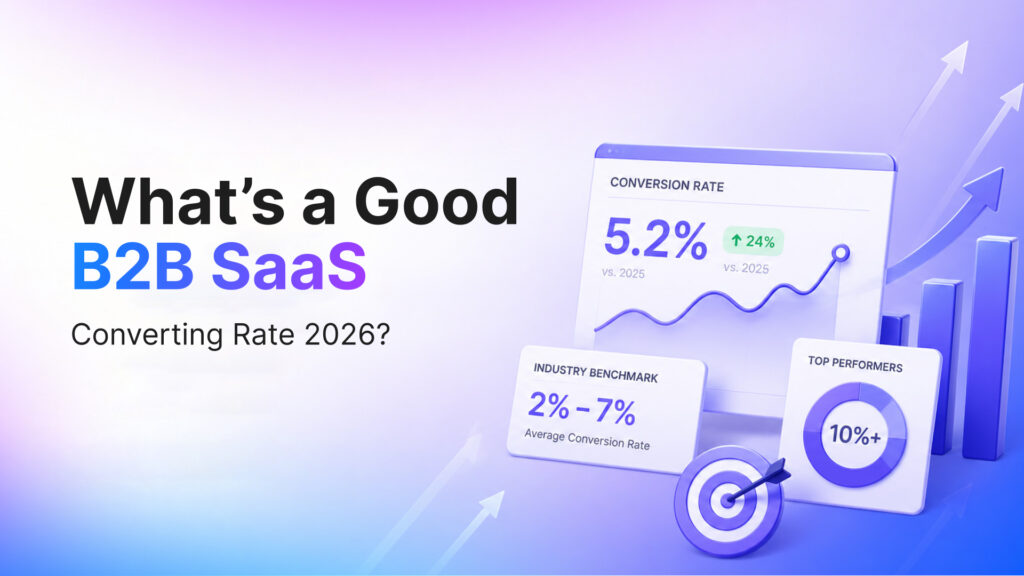
A useful benchmark for SaaS landing pages is around the low single digits, but the exact figure depends on the type of page, traffic, industry, and conversion being measured.
The important thing is not to treat one benchmark as a universal target.
For example, a landing page built for a high-intent paid-search campaign can behave very differently from a blog post receiving broad organic traffic.
A useful way to think about SaaS conversion benchmarks is:
| Metric | What it tells you |
|---|---|
| Visitor → Lead | How effectively your website generates leads |
| Landing Page → Signup | How effectively a specific page drives action |
| Visitor → Free Trial | How well your product attracts trial users |
| Demo → Opportunity | How effectively demos create sales opportunities |
| Free Trial → Paid | How well trial users become customers |
The right benchmark is the one that matches your business model and conversion goal.
SaaS landing page conversion rate vs website conversion rate
This distinction is easy to miss.
A website conversion rate can include visitors landing on:
- Blog posts
- Homepage
- Pricing pages
- Product pages
- Documentation
- Industry pages
- Campaign pages
A landing-page conversion rate usually refers to a specific page built around a particular conversion goal.
That means a blog visitor and a paid-search visitor may have completely different intent.
Consider this example.
Blog visitor
Searches:
“What is SaaS marketing?”
They read your article and leave.
That’s not necessarily a failed conversion. Their goal may have been learning.
Paid-search visitor
Searches:
“AI landing page builder”
Clicks your ad and lands on a page offering an AI landing-page builder.
That visitor is much closer to a commercial decision.
If you combine both into one website-wide conversion rate, you lose important context.
Conversion rate should always be analyzed alongside page intent and traffic source.
What counts as a conversion in B2B SaaS?
A conversion isn’t always a purchase.
Depending on your business model, a conversion could be:
- Book a demo
- Start a free trial
- Create an account
- Request a consultation
- Submit a lead form
- Download a resource
- Sign up for a webinar
- Start using the product
- Upgrade to a paid plan
The right conversion depends on your funnel.
For a product-led SaaS company, free signup may be the primary conversion.
For enterprise SaaS, demo request might matter more.
For a demand-generation campaign, qualified lead may be the real goal.
This is why increasing the number of form submissions isn’t always the same as improving marketing performance.
You want more useful conversions, not simply more conversions.
B2B SaaS conversion rates by funnel stage
B2B SaaS companies typically have several conversion points.
A simplified funnel looks like:
Visitor → Lead → MQL → SQL → Opportunity → Customer
You may also have a product-led path:
Visitor → Signup → Activated User → Paid Customer
Published benchmark ranges vary considerably by company type and methodology, so treat them as directional rather than fixed targets.
A useful framework is:
| Funnel stage | What you’re trying to understand |
|---|---|
| Visitor → Lead | Is the page attracting and converting the right audience? |
| Lead → MQL | Are you generating qualified interest? |
| MQL → SQL | Are marketing-qualified leads actually sales-ready? |
| SQL → Opportunity | Are sales conversations producing real opportunities? |
| Opportunity → Customer | How effectively does sales close qualified demand? |
| Free Trial → Paid | How well does the product convert activated users? |
Don’t optimize every stage at once.
Find the biggest leak first.
If your website generates plenty of qualified leads but almost none become opportunities, creating more landing pages may not be the answer.
If your paid campaigns generate thousands of clicks but very few leads, the landing-page experience deserves closer attention.
What affects SaaS conversion rates?
1. Traffic quality
Traffic volume doesn’t tell you much by itself.
A page receiving 10,000 highly targeted visitors can outperform one receiving 100,000 low-intent visitors.
For example:
“What is SaaS?”
is informational.
“Best SaaS landing page builder”
is much closer to a buying decision.
The second audience is more likely to convert because the search intent is closer to the solution.
2. Message match
Your ad, search result, and landing page should feel like parts of the same conversation.
If your ad says:
Build SaaS landing pages with AI
and your landing page opens with:
Modern digital experiences for growing businesses
the visitor has to figure out whether they’ve landed in the right place.
That’s a problem.
A stronger match would be:
Build conversion-focused SaaS landing pages with AI.
The visitor immediately knows they’re in the right place.
3. Offer
Not every offer asks for the same level of commitment.
Compare:
- Download a checklist
- Watch a webinar
- Start a free trial
- Book a demo
- Request a sales consultation
The more commitment you ask for, the more value and trust you usually need to communicate first.
4. Sales cycle
A self-serve SaaS product can convert a visitor into a customer quickly.
Enterprise SaaS might involve:
- Multiple stakeholders
- Security reviews
- Procurement
- Legal
- Budget approval
A visitor who doesn’t convert today may still become a customer months later.
That’s why short-term page conversion shouldn’t always be treated as the complete picture.
5. Pricing
Pricing affects buying behavior.
A $19/month self-serve tool and a $50,000/year enterprise platform aren’t going to have identical conversion patterns.
The higher the perceived risk and commitment, the more important trust, proof, clarity, and product understanding become.
6. Brand awareness
A well-known SaaS brand may need less explanation because visitors already recognize it.
A newer company has to build that trust on the page.
Useful trust signals include:
- Customer logos
- Testimonials
- Case studies
- Product screenshots
- Reviews
- Security information
- Clear pricing
- Product demonstrations
When someone doesn’t know your brand, every part of the page has to do more work.
7. Landing-page experience
Your landing page needs to answer five questions quickly:
What is this?
Who is it for?
Why should I care?
Why should I trust it?
What should I do next?
If visitors need to search around for those answers, you’re adding friction.
How traffic source changes conversion rates
Not all traffic behaves the same way.
Organic search
Organic traffic can contain several levels of intent.
Someone searching:
“how to create a SaaS landing page”
may still be researching.
Someone searching:
“SaaS landing page builder”
is closer to evaluating a product.
Your content and landing page should reflect that difference.
Paid search
Paid search gives you the opportunity to target high-intent keywords.
For example:
AI landing page builder
The visitor already has a problem and is looking for a solution.
But you’re paying for every click.
That means a poorly converting landing page can make your acquisition costs much higher.
If you’re spending $5 to acquire a click and your landing page converts 1% of those visitors, you’re paying for a lot of traffic before generating a lead.
Improving conversion means getting more value from the clicks you’re already buying.
Social traffic
Social traffic can be less predictable.
Someone might click because the creative caught their attention rather than because they’re actively looking for your product.
That doesn’t make social traffic bad.
It simply means your landing page may need to do more work to establish context and intent.
Email traffic
Email audiences are often more familiar with your brand or offer.
The important takeaway isn’t that one traffic source will always outperform another.
It’s that traffic source changes the conversion context.
Why SaaS landing pages convert differently
SaaS products can be difficult to explain.
A physical product can often be understood from an image.
Software usually requires visitors to understand:
- What it does
- How it works
- Who it’s for
- Why it’s better
- What problem it solves
- Why they should trust it
That’s a lot of information.
This is one reason SaaS landing pages need particularly clear messaging.
The practical lesson is simple:
Don’t make visitors work to understand your product.
A strong SaaS landing page should make the value obvious before asking the visitor to take action.
Homepage vs. landing page for SaaS
Your homepage has a broad job.
It may need to explain:
- Your company
- Multiple products
- Different use cases
- Different audiences
- Navigation
- Resources
- Customers
That’s fine.
But a campaign landing page has a narrower job.
It can focus on:
One audience.
One problem.
One offer.
One action.
For example:
Generic homepage
AI-powered tools for modern marketing teams.
Campaign landing page
Build SaaS landing pages with AI—without waiting for a developer.
The second message is much more specific.
If someone searched for an AI landing-page builder, the second page is more closely aligned with what they wanted.
9 Ways to improve your SaaS conversion rate
1. Match the landing page to search intent
Don’t send someone searching for a specific solution to a generic homepage.
Create a page that answers the specific problem they were trying to solve.
2. Make your value proposition obvious
Visitors shouldn’t have to read five sections to understand what you do.
Your headline and supporting copy should communicate:
What you offer + who it’s for + why it matters.
3. Use one primary CTA
If the page has:
- Book a demo
- Contact sales
- Start free trial
- Learn more
- Download guide
all competing for attention, the visitor has to decide what to do.
Give the page one primary action.
4. Remove unnecessary friction
Look at your forms.
Do you really need:
- Job title?
- Company size?
- Phone number?
- Country?
- Website?
- Ten different fields?
If you don’t need the information immediately, consider removing it.
5. Add relevant proof
Don’t just say your product works.
Show why visitors should believe you.
Use:
- Testimonials
- Customer logos
- Case studies
- Product screenshots
- Reviews
- Results
Keep the proof relevant to the audience you’re targeting.
6. Optimize for mobile
Don’t design the desktop version and treat mobile as an afterthought.
Check:
- Headline length
- CTA visibility
- Form usability
- Page speed
- Navigation
- Image sizes
- Spacing
A page that looks good on desktop can still be difficult to use on a phone.
7. Simplify your copy
If visitors need to reread your headline to understand it, rewrite it.
Use plain language.
Instead of:
Accelerate synergistic marketing workflows through intelligent digital experiences.
Say:
Launch landing pages without waiting for developers.
The second sentence tells the visitor what they can actually do.
8. Test one meaningful variable at a time
You don’t need to redesign the entire page every week.
Test things like:
- Headline
- CTA
- Offer
- Social proof
- Form length
- Page structure
Then measure what changed.
9. Create pages for different audiences
A founder and a performance marketer don’t necessarily care about the same thing.
A founder might want:
Lower cost + faster launch.
A marketer might want:
More experiments + faster campaign execution.
Build messaging around the reason that particular audience cares.
The conversion gap: more leads without more traffic
Here’s why conversion optimization matters financially.
Imagine two SaaS companies receive the same traffic.
Company A
100,000 visitors
2% conversion
2,000 leads
Company B
100,000 visitors
5% conversion
5,000 leads
Company B generates 2.5× more leads from exactly the same traffic.
It didn’t need another 100,000 visitors.
It improved the experience for the visitors it already had.
That’s the conversion gap.
And it’s why increasing traffic isn’t always the fastest growth lever.
Sometimes the bigger opportunity is sitting inside the traffic you’re already paying for.
Why creating more landing pages becomes a bottleneck
Once you understand the value of relevant landing pages, another problem appears.
You need more of them.
One campaign might need pages for:
- Different ICPs
- Different industries
- Different keywords
- Different offers
- Different funnel stages
Then you want variations for A/B testing.
Suddenly, one campaign doesn’t mean one page.
It can mean five, ten, or more versions.
The traditional workflow can become:
Marketer → Copywriter → Designer → Developer → Review → Publish → Analytics → Test
Every handoff adds time.
And when launching a page takes days or weeks, marketing teams naturally run fewer experiments.
That creates a second problem:
You can’t optimize what you can’t test.
How Vounce helps SaaS teams create and optimize landing pages
This is where Vounce fits.
Vounce is built around a simple problem:
Marketing teams need to create, publish, measure, and iterate on landing pages faster.
Instead of turning every campaign page into a separate project for designers and developers, teams can use AI to accelerate the landing-page creation process.
That makes it easier to build pages around:
- Different ICPs
- Search intent
- Paid campaigns
- Industries
- Offers
- Funnel stages
Vounce can also bring more of the workflow into one place, including landing-page creation, publishing, analytics, conversion tracking, popups, lead management, domains, and integrations.
The point isn’t to generate hundreds of pages just because AI makes it possible.
The point is to make relevant experimentation easier.
Create a page.
Publish it.
Measure what happens.
Learn.
Improve it.
Then test the next idea.
That’s a much more useful way to think about AI landing-page generation.
Final takeaway
So, what is a good B2B SaaS conversion rate in 2026?
There isn’t one number.
Your real benchmark should be based on:
- Your traffic
- Your audience
- Your offer
- Your sales motion
- Your conversion goal
- Your historical performance
The more useful question is:
Where is the biggest conversion gap in your funnel?
If 100,000 visitors convert at 2%, you get 2,000 leads.
At 5%, you get 5,000.
That’s 3,000 additional leads without purchasing another visitor.
For SaaS teams, conversion optimization isn’t just about changing button colors or rewriting headlines.
It’s about creating a better match between the person, the problem, the message, and the page.
And when your team can create and test those experiences faster, you have more opportunities to find what actually converts.
// FAQs
Frequently Asked Questions
There is no single conversion rate that works for every SaaS company. A good rate depends on your traffic source, audience, offer, industry, and conversion goal. The most useful benchmark is one based on pages with similar intent and traffic.
Use this simple formula:
SaaS Conversion Rate = (Number of Conversions ÷ Total Visitors) × 100
For example, if 5,000 visitors generate 150 leads:
150 ÷ 5,000 × 100 = 3% conversion rate
A website conversion rate can include visitors across your homepage, blog, pricing pages, product pages, and other sections. A landing page conversion rate usually measures a specific action on a focused page, such as signing up, booking a demo, or starting a trial.
Because the traffic and intent can be different, these rates shouldn’t be compared directly.
Start by matching your landing page to the visitor’s intent. Then focus on a clear value proposition, a strong primary CTA, relevant social proof, shorter forms, mobile optimization, and continuous A/B testing.
Small improvements across these areas can make a significant difference when you’re already generating substantial traffic.
There is no ideal number. Instead of creating landing pages simply to increase the count, build pages around different ICPs, campaigns, keywords, industries, use cases, and offers when the audience or intent is meaningfully different.
The goal is to create more relevant experiences—not simply more pages.