Landing Pages Shouldn’t Take Weeks
Summarize this blog with AI:
Table of Contents
- The Campaign Is Ready. The Landing Page Isn’t.
- The result?
- The question is: Why do landing pages take so long?
- Startups ought to realize
- The business climate is increasingly driven by speed
- Several reasons why traditional landing page development is slow.
- AI is revolutionizing landing page creation
- Create pages without coding.
- Tips to create landing page quickly
- Implementing landing page automation makes scaling easier
- The Challenge: Launch campaigns faster and generate more insights.
- Rapid page deployment means teams are agile.
- If you’re a marketer, you need to select
- AI website builders are expanding possibilities
- Real Business Impact
- In the future, landing pages will be even quicker
- Final thoughts
- FAQs
In today’s marketing world, it takes only days, if not hours, to become obsolete. So should your page targeting. So should your landing pages.
The Campaign Is Ready. The Landing Page Isn’t.
Imagine your ad creatives have been approved, emails have been fine-tuned, and your campaign strategy is finalized. You’ve got everything set up, except for the landing page.
A lot of changes are made in the design. The developers are in the midst of product releases. Marketing waits. Launch dates keep slipping.
The result?
The campaign is not only delayed, but opportunities go down the drain as competitors campaigns move ahead at a faster pace.
“Rare” doesn’t apply in this case. One of the primary constraints of today’s marketing.
The teams that succeed today aren’t asking themselves how to make their landing pages prettier.
Instead, they’re asking:
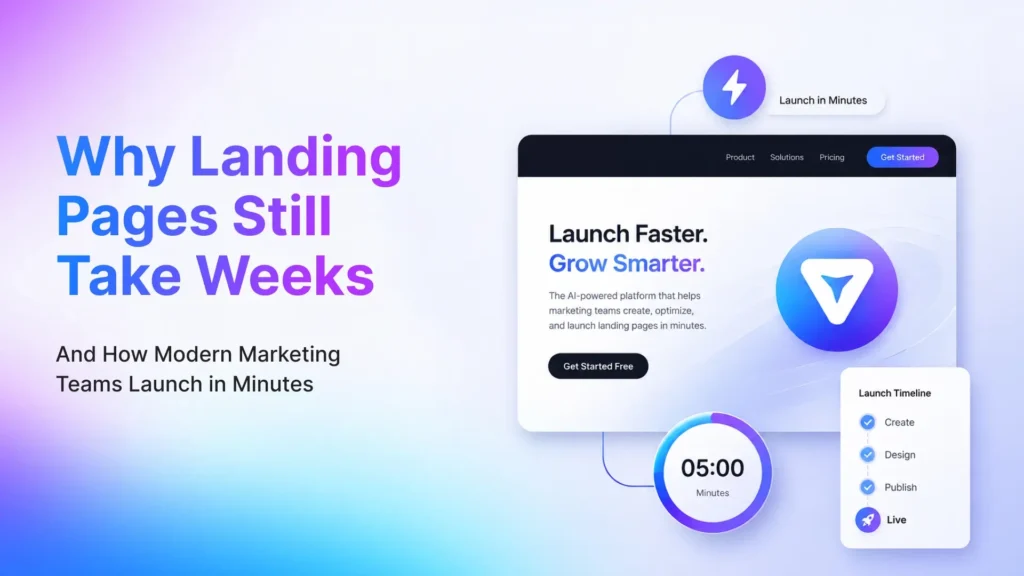
How can we create landing pages in minutes instead of waiting weeks or even months?
The solution is to use an intelligent landing page builder, an AI landing page generator, and efficient marketing processes.
The question is: Why do landing pages take so long?
Though the digital marketing landscape has progressed, a lot of companies are still stuck with outdated production processes.
The typical landing page will include:
- Marketing teams writing copy
- Designers creating mockups
- Developers write the code for the landing page.
- QA teams test the page for responsiveness across devices.
- Stakeholders review and request revisions.
- Marketing is in a waiting status.
Some pages are likely to involve multiple departments, even if they are simple.
The landing page is the slowest part of the campaign, rather than helping speed up the campaign launch.
Ironically, the page that’s supposed to increase conversions ends up slowing the entire campaign process.
Businesses ought to realize :
These hidden costs add to the overall cost of slow landing pages.
For most marketers, delayed pages are just postponements of possible launches.
In reality, the impact is much greater.
When the production of landing pages is slow, it leads to the following:
- Missed seasonal opportunities
- Higher campaign costs
- Reduced testing frequency
- Lower marketing agility
- Fewer optimization cycles
- Lost competitive advantage
The fewer experiments your team runs, the less they accomplish if they’re launching only one page every few weeks.
That means that there is less know-how.
Ultimately, it all leads to fewer conversions.
The business climate is increasingly driven by speed — to succeed, you must be quick.
The times have changed, and so has marketing.
Teams launch:
- Product updates weekly.
- Paid campaigns daily.
- Social promotions instantly.
- Email sequences automatically.
However, traditional workflows are still frequently adhered to when creating landing pages.
This is why companies have started using landing page creation tools that enable faster page creation and eliminate unnecessary bottlenecks.
Marketers can publish the pages the same day of the campaigns instead of waiting weeks.
Several reasons why traditional landing page development is slow.
There tend to be a lot of delays that are not due to complicated designs.
These are the results of PROCESS.
A typical workflow would be like this:
Design thinking is the process that involves making an idea, designing the idea, getting feedback, developing the design, quality checking the design, deployment, getting more feedback, and launching the design.
All the passes cause delays.
Each revision entails another approving process.
All dependencies slow marketing down.
That’s why contemporary landing page software emphasizes empowering marketers, not just developers.
AI is revolutionizing landing page creation.
AI is revolutionizing the way marketers are developing campaign assets.
Rather than working on a blank canvas, an AI landing page generator can create a landing page in a heartbeat:
- Headlines
- Hero sections
- Layout suggestions
- Calls-to-action
- Content blocks
- Verbal representations and given designs
AI doesn’t take the place of creativity; it is just removing repetitive work.
Marketers spend more time refining messaging than building page structures.
This is the basis for creating landing pages with AI.
Create pages without coding
Developer dependency is one of the major reasons for the delay of the projects.
Developers are a great asset; don’t make them work on landing pages when you could be focused on product development.
With a no-code landing page builder, marketing teams can:
- Cut and paste parts
- Update content instantly
- Publish changes independently
- Set up several different campaigns.
- Try out new concepts in a swift manner.
What you get is a lot more marketing agility.
Marketing teams no longer have to wait for resources before launching campaigns.
Tips to create landing page quickly:
If you have any questions regarding how to create landing pages in minutes, then you’re in for a surprise. Creating landing pages in minutes is a relatively simple process, especially with the right tools.
- Start with an AI-generated template tailored to your campaign goals.
Select your campaign goal, and let AI create an initial layout.
- Customize your messaging
Use headlines, offers, and CTAs that match your audience.
- Add branding
Use logos, colors, images, and fonts in a consistent way.
- Optimize for conversions
Use testimonials, trust badges, benefit copy, and powerful CTAs.
- Publish instantly
Get your page live in no time at all for development cycles.
The whole procedure can even be conducted within an hour.
AI isn’t a “marketer,” but rather, it’s a “marketer’s coach”.
AI-generated landing pages are often considered cookie-cutter solutions.
In fact, AI is just a starting point.
Marketing staff continues to make decisions:
- Brand voice
- Campaign strategy
- Customer messaging
- Value propositions
- Conversion goals
AI merely deals with rote tasks that are connected with manufacturing.
Consider it to be a very efficient “assistant,” not a replacement.
Implementing landing page automation makes scaling easier
Effortless marketing isn’t necessarily regarding producing one gorgeous webpage.
It’s all about optimization of multiple pages.
It is here where landing page automation comes in handy.
Automation helps teams:
- Duplicate successful campaigns
- Reuse proven layouts
- Generate variations rapidly
- Personalize landing pages
- Go multi-product and multi-audience.
Marketers will not build out a page from scratch but instead build systems that will scale.
The Challenge: Launch campaigns faster and generate more insights.
The Benefit: Faster campaigns mean more learning.
Speed isn’t the only advantage of artificial intelligence.
It’s the ability to experimentation.
With faster page creation, you can test:
- Multiple headlines
- Different offers
- Alternative layouts
- CTA variations
- Pricing messages
- Audience-specific messaging
This will not only allow for quicker campaigns to be launched using AI but also allow for more opportunities to optimize the campaigns.
The more tests that are performed, the better the data will be.
The higher the quality of data, the higher the conversion rates.
Rapid page deployment means teams are agile.
Responsive marketers are in business today.
Whether it’s responding to:
- Industry trends
- Product launches
- Seasonal events
- Competitor activity
- Customer feedback
Teams must be deployed quickly, on a page.
Having a landing page take 2 weeks is a lot of time.
The publishing time of just hours gives one a lot of competition.
If you’re a marketer, you need to select the best landing page builder for your needs.
All platforms aren’t created equal for marketing teams.
Marketers should be able to use the best landing page builder, which should provide them with the following:
- AI-assisted page generation
- Drag-and-drop editing
- Responsive templates
- Built-in analytics
- A/B testing capabilities
- CRM integrations
- Marketing automation compatibility
- Fast publishing
- Collaboration features
It’s not just creating pages until the end of the goal.
It is helping marketers to roll out, test, optimize, and repeat without any issues.
AI website builders are expanding possibilities.
With AI-driven website builders, the possibilities are growing exponentially.
Many contemporary AI internet website-building systems currently have landing web page capabilities instead of merely web page development.
This enables the businesses to:
- Maintain brand consistency.
- Launch campaign microsites.
- Build event pages.
- Create product launches.
- Create lead generation funnels.
- Develop and publish lead generation websites.
Teams can consolidate their digital experiences instead of doing it on a number of platforms.
Real Business Impact
Businesses that use AI in landing page creation can see their workflows drastically improve in the following ways:
- Shorter production timelines
- Increased campaign velocity
- More A/B testing
- Improved collaboration
- Reduced development costs
- Better resource allocation
The most significant benefit is that marketers are able to take control of their launch dates.
Avoid waiting until a page is completed to get it ready for campaigns; they can get it ready as soon as the market needs it.
In the future, landing pages will be even quicker.
The marketing machine keeps on ticking, ticking, ticking!
Your customers aren’t waiting, and neither is the market.
What once took weeks can now be done in minutes.
The right landing page builder, combined with AI-powered tools and no-code capabilities, helps you eliminate unnecessary steps and focus on what matters most—creating landing pages that convert.
The future of AI means that this question won’t even be asked anymore, as your team will be able to create landing pages in no time at all.
The real question is: Can you afford not to?
Final Thoughts
These days, landing pages are no longer simply a point of entry: They are vital pieces of each and every marketing campaign. Making, publishing, and optimizing them sooner will result in your business learning and growing sooner.
With the ability to quickly build pages, automate them and use AI-driven workflows, marketers are able to stay on pace in today’s fast-changing digital world. You can now invest in getting campaigns up and running, testing and getting better customer experiences, without having to go through teams for weeks.
Today, speed, in marketing, is no longer a luxury; it’s a necessity: it’s a competitive edge. The teams that manage to disrupt the friction in creating pages and processes will be the teams that will start quicker and more efficiently, will do more iterations, and will perform better than everyone else consistently.
// FAQs
Frequently Asked Questions
An AI landing page generator is a machine that generates landing pages by leveraging AI capabilities, rather than relying on conventional methods.
Utilize AI templates and drag-and-drop editor to build with a no code landing page builder.
It enables campaigns to be launched quicker, optimizes testing and boosts marketing agility.
The best landing page builder provides AI capabilities, user-friendly customization, seamless integrations, analysis, and quick publishing.
Modern no-code landing page builders let marketers create, customize, and publish landing pages without writing code. Many also include AI-powered features that speed up page creation and optimization.