Manual optimization always starts too late
Summarize this blog with AI:
Performance marketing has traditionally been all about timely, experimental, and quantifiable results. As customer journeys become longer and the number of marketing channels increased, there is a challenge with keeping up the traditional methods of optimization.
Marketers today run campaigns across multiple channels, including search, social media, email, display advertising, and landing pages. Each decision-making delay can result in lost conversions, given up ad budget, and lost revenue.
That’s where AI marketing automation is revolutionizing the way things are done.
Table of Contents
- The reason why conventional campaign optimization doesn’t work.
- The advent of AI marketing automation. With the emergence of AI marketing automation.
- The ultimate in automated A/B testing – at scale
- Campaign Optimization Tools Based on Proactive Optimizing are Replacing Reactive Workflows.
- No-code marketing tools make AI accessible. AI accessible with no-code marketing tools.
- The Future of Performance Marketing is Autonomous
- Conclusion
- FAQs
The reason why conventional campaign optimization doesn’t work.
There are still a lot of manual processes in place in most marketing teams.
Campaign managers track dashboards, review reports, look for trends, and make changes as necessary, based upon performance data. This strategy proved to be effective in simpler campaigns but poses big problems in this context:
- Delayed optimization decisions
- Missed conversion opportunities
- Slow experimentation cycles
- Increased operational overhead
- Performance that varies from one channel to another.
- Anomalies in performance from channel to channel.
Thousands of performance signals are processed every minute; even the most savvy marketers cannot deal with it all on a manual basis.
The more intricately an organization becomes involved in its campaign, the more important it is that there are performance marketing tools to detect problems and automatically make recommendations or implement them.
The advent of AI marketing automation. With the emergence of AI marketing automation.
AI isn’t just for reporting and analyzing. The marketing operations software of today is involved in the marketing process.
Advanced AI systems are continually analyzing:
- Conversion rates
- User behavior
- Audience engagement
- Ad performance
- Funnel drop-off points
- Landing page effectiveness
AI doesn’t just simply point out issues; it recognizes opportunities and takes action on them.
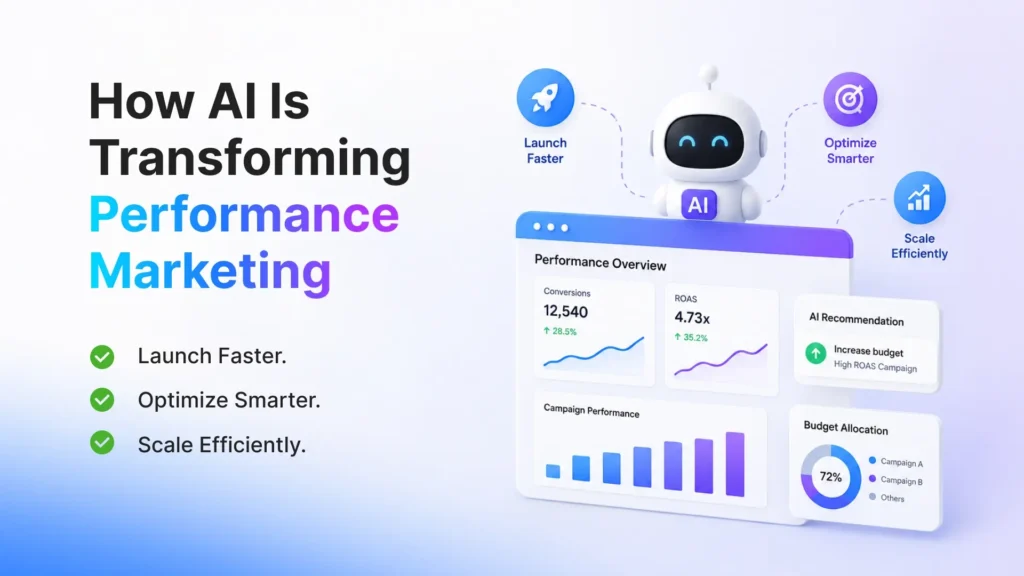
With this move from a reactive optimization approach to a proactive optimization approach, growth teams are scaling campaigns without adding to their operational complexity.
The ultimate in automated A/B testing – at scale.
Some of the greatest benefits of AI-powered marketing platforms are automated A/B testing.
Traditional A/B testing tends to involve marketers in having to do the following:
- Create multiple variations.
- Launch experiments manually.
- Monitor results.
- Analyze data.
- Implement winners.
It may take several days or weeks to do this.
AI substantially speeds up and streamlines this process.
Experiments can be automatically generated, launched, monitored, and optimized on-the-fly based on the performance data of the modern campaign management platform.
Normally, one tests different variables one at a time, but AI can test several variables at once, such as
- Headlines
- Ad creatives
- Calls-to-action
- Landing page layouts
- Audience segments
- Budget allocation
This translates to quicker learning and higher conversions.
The new generation of landing pages will be smarter. Smarter landing pages will be the new ones.
The campaign has only just begun. Once it is finished, it is time to get results.
Often, visitors to a site become familiar with that site for the first time on that site’s landing page.
Many companies spend lots of money on advertising but do not optimize their landing pages.
AI-enabled systems help eliminate this problem through tracking user engagement and identifying any blocks to conversion.
These systems are able to analyze the following:
- Scroll depth
- Click behavior
- Bounce rates
- Session engagement
- Form completion rates
AI makes suggestions or automatically implement changes for better conversion, based on the insights.
AI-powered landing page optimization can have a profound impact on the performance of campaigns when coupled with automated testing—without the need for a ton of handwork.
Every performance marketing campaign is meant to be simple; that is, it’s supposed to get more conversions for less expense.
An AI conversion optimization platform can help in doing this by recognizing trends that humans might miss.
As an example, by learning that:
- Some consumers tend to convert at certain times of the day.
- There are particular combinations of creativity that work better than others.
- Some traffic sources have a better lead quality.
Specific page features work against the landing page.
AI’s constant stream of processing leads to quicker optimizations compared to manual processes.
This allows marketers to concentrate on strategy, allowing the AI to take care of the repetitive optimization tasks.
Campaign Optimization Tools Based on Proactive Optimizing are Replacing Reactive Workflows.
Not many marketing teams are able to find problems until the performance of the campaign has dropped.
When they discover the problem, it’s too late in the game to save valuable budget and conversions.
That’s why companies are increasingly getting more sophisticated with their campaign optimization tools and are increasingly moving towards proactive optimization.
The tools track the health of campaigns on an ongoing basis and detect health warning conditions that will prevent performance from declining.
Examples include:
A sudden decrease in conversion rate, or drop from one conversion rate to another.
- Increasing costs of acquiring customers
- Audience fatigue
- Declining engagement metrics
- Underperforming landing pages
The marketers can avoid reacting to poor performance by anticipating issues and preventing them from affecting the revenues.
With marketing workflow automation, the time it takes to execute becomes quicker.
Optimization is just one of the factors.
Marketing teams also invest a good amount of time in work of the Operational and Management type like:
- Reporting
- Campaign approvals
- Asset management
- Experiment tracking
- Budget monitoring
This is a burden on administration and delays execution.
An automated marketing workflow can help alleviate these issues by automating repetitive tasks and getting campaigns launched faster.
Workflow automation is used in conjunction with growth marketing tools to enable organizations to:
- Reduce manual work
- Accelerate campaign launches
- Improve collaboration
- Increase operational efficiency
- Reducing costs of marketing while scaling up the operations
No-code marketing tools make AI accessible.
Typically, high-tech marketing tech needed tech expertise.
However, today, no code marketing tools are making AI-optimized marketing tools available to all marketing teams.
Marketers can create workflows, run experiments, orchestrate optimization rules, and run campaigns without depending on engineering resources.
This gives any team, regardless of size, access to advanced AI automation features.
Consequently, organizations can innovate quicker and make the innovation less complex to implement.
The key features to consider for an AI campaign optimization platform are: The main characteristics to consider for an AI campaign optimization platform are:
Not every optimization solution will have the same value.
Marketers should look at platforms based on such features as the following:
- Real-Time Optimization
The platform needs to be continually testing performance and to enhance without having to be manually altered.
- Automated A/B Testing
Seek solutions to make experimentation simple and learning cycles faster.
- Landing Page Optimization
The platform should offer actionable tips and recommendations that will improve conversion.
- Cross-Channel Campaign Management
A modern campaign management platform should be efficient on all channels with one platform.
- Workflow Automation
Good marketing workflow automation features enable the elimination of inefficiencies in operation.
- Predictive Insights
The best platforms are able to see trends coming and take advantage of them prior to their effects on campaigns.
The Future of Performance Marketing is Autonomous
The future of marketing is one where a considerable amount of the operational and optimization tasks will be taken care of by AI.
Marketers can focus on the following: Rather than spend hours looking at reports and making manual adjustments to campaigns, marketers can:
- Strategy
- Creative direction
- Customer experience
- Growth initiatives
AI is constantly testing, learning, and optimizing the background.
This development is spawning a new class of performance marketing solutions that are quicker, wiser, and more effective than the legacy solutions.
Conclusion
With more and more competition and changing customer needs, manual optimization techniques are no longer enough.
AI marketing automation, AI campaign optimization, and marketing operations software are just some of the benefits that businesses can enjoy with faster execution, smarter decision-making, and higher conversion rates.
AI is driving marketing teams to grow at scale, whether it’s optimizing with automation, optimizing landing pages, or providing sophisticated conversion rate optimization.
The debate on the use of AI in marketing is not about whether, but how!
Now the big question is: are you ready to no longer lose them to conversions with the help of AI optimization and instead let an AI tool that optimizes them for you take you to your next growth stage? This version is optimized for getting search engine rankings and naturally features all the main and secondary keywords and follows a SaaS/B2B marketing blog format.
// FAQs
Frequently Asked Questions
AI marketing automation automates campaign management and optimization using artificial intelligence.
Performance marketing tools improve campaign efficiency and maximize ROI.
A campaign management platform centralizes campaign planning, execution, and tracking.
Landing page optimization helps increase conversions from existing traffic.
Conversion rate optimization improves the percentage of visitors who take desired actions.