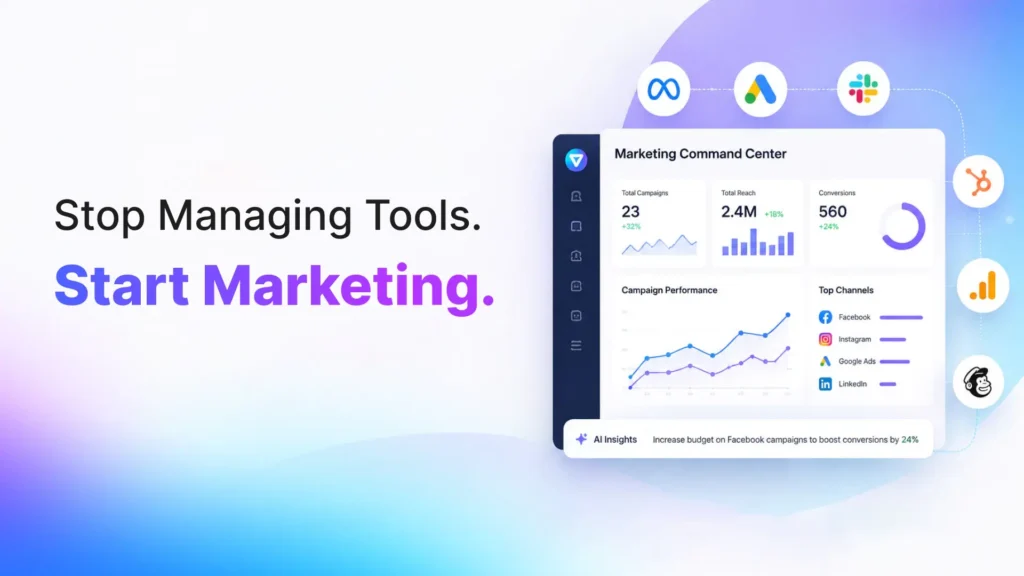
Marketing Teams Need Fewer Tools, Not More
Summarize this blog with AI:
Table of Contents
- But Marketing Teams Use Too Many Tools—Why?
- Reduced the efficiency of the marketing team
- Fragmented Campaign Management
- Poor Marketing Operations
- The Importance of Tool Consolidation
- The ultimate goal of a marketing automation (MA) tool
- How the Reduction of Tools will Enhance Marketing Productivity
- Workflow Automation Generates Consistency
- Seamless AI-driven marketing workflows.
- Creating a more intelligent Marktech stack
- Final Thoughts
- FAQs
Marketing Teams Need Fewer Tools, Not More
Today’s marketing teams have access to a much wider variety of software options than ever in the past. At the very least there’s been an explosion of various email marketing platforms, analytics dashboards, CRM systems, social media schedulers, design tools, and AI assistants that comprise the average marketing technology stack. No matter how brilliant each of the solutions may be, it often leads to complexity when all solutions are rolled up together.
Many businesses feel that just because it is more of a platform, it’s better for results. In fact, too many tools can actually hinder the ability to move teams faster, inhibit the creation of a seamless workflow, cost more, and decrease the transparency of campaigns. Rather than boosting marketing productivity, marketers waste precious time moving through tabs, operations, and applications and copying/pasting data, then dealing with integration risks.
The future of marketing isn’t about marketing stacks. The real issue of the future isn’t about marketing stacks; it’s about the future of marketing. It’s about creating a streamlined environment where all tools can contribute and facilitate efficient execution and quantifiable growth.
But Marketing Teams Use Too Many Tools—Why?
One of the leading causes of companies getting software in the first place is because marketing changes even quicker than their inner processes. Each campaign poses a new challenge, and each challenge has a corresponding solution.
Common reasons include:
A random group of teams making separate software purchases. Various teams making their own purchases of software.
Traditional GAE platforms that were never rebuilt. Legacy platforms not rebuilt.
- Tools that are specifically designed for a single marketing task
- Quickly implementing the new AI solutions
Poor integration of technology planning with other aspects of the school community
This is why marketing teams feel they aren’t using enough tools, although they know how ineffectual these might be.
Many times as an organization expands, it finds a bunch of tools with similar functions. One team works with one analytics solution, one team works with another reporting solution, and campaign data is in a number of disparate systems.
The software ecosystem is not designed to make collaboration an easier task, but it does end up with information silos.
The problem of an overloaded MarTech stack is hidden and hard to detect.
The price of a straight subscription isn’t the only issue.
In addition to that, when confronted with the setup of a bigger marketing technology stack, one faces unknown operational costs that impact each and every campaign.
Reduced the efficiency of the marketing team
Marketers who are frequently switching between apps aren’t going to be very productive.
Everything as simple as campaign launches can result in updating several dashboards, downloading reports in spreadsheets, and double-checking your information.
Doing something to make the marketing team more effective will make it easier to get rid of unnecessary software.
Fragmented Campaign Management
Disconnected systems make campaign management more challenging.
As a result, marketers often struggle to answer questions such as:
- What is the best campaign?
- Which landing page is working the best for you?
- What generates the best ROI in terms of channels?
Without centralized visibility, decisions are based on assumptions rather than data.
Poor Marketing Operations
The backbone of good marketing operations is good processes!
With each workflow transcending across 5-6 platforms, it becomes hard to keep them consistent.
This results in problems with version control, duplicated work, different reports, and delays in communication—problems that quickly become common.
The Importance of Tool Consolidation
Regardless of the other smart investment decisions a company makes, one of the smartest is tool consolidation.
It’s better for businesses to assess their current systems to determine whether they already offer comparable features than to buy an additional platform.
Consolidating marketing tools has a number of benefits, such as:
- Lower software costs
- Faster campaign execution
- Easier onboarding
- Better collaboration
- Improved reporting accuracy
- Reduced maintenance
- Less integration complexity
In the words of Doug, “The consolidation isn’t about taking away the technology.
It’s all about doing away with something that doesn’t need to be.
The key to successful marketing workflow optimization is working the kinks out of your workflow.
Let’s imagine, for instance, you’re launching a campaign.
If it’s NOT optimized, marketers may possibly
- Create assets in one platform.
- Create landing pages for users to land on.
- Manually send the approval email.
- Upload creatives separately.
- Schedule campaigns individually.
- Generate reports that can be downloaded as spreadsheets.
The more your process steps, the greater the risk of the process being delayed or there being a mistake.
A streamlined workflow rolls these activities together into a streamlined process that provides automatic movement of information rather than manual.
It helps develop a greater sense of teamwork and minimizes repetitive work.
The ultimate goal of a marketing automation (MA) tool should be to cut down on work and not add to it.
Many organizations get more marketing automation software because they think that only automating their systems can help them solve their problems.
Unfortunately, the automated system in different systems can be much more complex.
For example:
- One platform automates e-mailing.
- Another one is for automating social publishing.
- A third task is to update the CRM.
- A fourth, “automates reporting.”
These particular automations operate independently.
Marketers don’t have a connected workflow but instead have multiple disconnected automation systems.
The ideal automation solution is to have one place and one source of truth for repeating processes.
Managing marketing tech stack complexity is about minimizing unnecessary complexity.
It’s important for every marketing leader to periodically assess software.
You don’t need to compromise on functionality when simplifying your marketing tech stack.
Instead, ask questions such as:
- Does the tool address a new or specific business problem?
- Does another platform already offer the same features?
- Will this software need to be integrated into our existing systems?
- Is the team actively using it?
- Does it have a positive impact on measurable results?
If it’s always “no,” then the platform might not need to be included in your stack.
How the Reduction of Tools will Enhance Marketing Productivity
The one thing many people don’t understand is that more software is not necessarily mean more capability.
The benefits of fewer tools that make marketing more productive will clearly be seen when teams spend less time dealing with the tools and more time producing impactful marketing campaigns.
With a simplified marketing environment, marketers can:
- Launch campaigns faster
- Reduce manual work
- Improve collaboration
- Access reliable reporting
- Respond to market changes more quickly
Instead of acting as software administrators, marketers can focus on building powerful customer experiences.
Workflow Automation Generates Consistency.
Effective workflow automation is more than just replacing manual processes.
It’s about making sure that all campaigns go through a repeatable, efficient process.
Automated approvals, asset management, reporting, notifications, and campaign deployment eliminate delays and enhance accuracy.
With a streamlined martech stack, automation can be much more efficient as there are fewer integrations to maintain.
Seamless AI-driven marketing workflows.
Smoothing out the AI-powered marketing process.
There are new opportunities for marketers with AI, but it’s when they integrate, not when they add more tools to their tech stack.
AI helps to streamline marketing workflows by seamlessly integrating intelligence right into the workflow.
AI can:
- Generate campaign ideas
- Streamline webpage copy
- Predict campaign performance
- Recommend audience segments
- Personalize customer experiences
- Offer relevant actionable insights automatically.
Rather than making an addition like another disconnected platform, AI should be used to improve the systems that marketers use every day.
This helps lessen the context switching and improve decision-making.
Creating a more intelligent Marktech stack.
A great marketing tech stack isn’t just some dozen applications.
Rather, it’s made up of selected tools that are designed to function together flawlessly.
The following are the essential elements of an effective marketing tech stack:
- Customer relationship management
- Content creation
- Analytics and reporting
- Campaign execution
- Marketing automation
- AI-powered optimization
All platforms should be designed around the overall process and not make it more complex.
The purpose of technology is to make work easier, not to be the work.
Final Thoughts
It’s not the number of tools your team has that will be the key to marketing success. It’s based on how these tools enable your people to complete campaigns, collaborate, and make data-driven decisions effectively.
Companies that adopt tool consolidation, more efficient marketing workflow optimization, and connected marketing automation tools are often more successful than other companies that are stuck with fragmented tools.
With marketing moving forward, it will be the business that makes things easy, gets rid of all the irrelevant technology, and focuses on efficiency over the amount of software.
It’s not about more tools for the future of marketing.
It’s smarter tools that are used together to maximize marketing productivity, the efficiency of the marketing team, the strength of marketing operations, and improved outcomes from a streamlined martech stack.
// FAQs
Frequently Asked Questions
Most teams start using platforms for different tasks and this creates a lot of confusion and extra work.
Tool consolidation helps teams reduce costs, collaborate better, improve reporting accuracy, and manage campaigns more efficiently.
When businesses use tools they do not have to do as much manual work they can get things done faster and they can make decisions quicker.
Marketers spend less time switching between platforms, giving them more time to create, optimize campaigns, and reach more people.
Artificial Intelligence automates tasks, improves campaigns in real time, provides useful insights, and helps marketers work more efficiently.