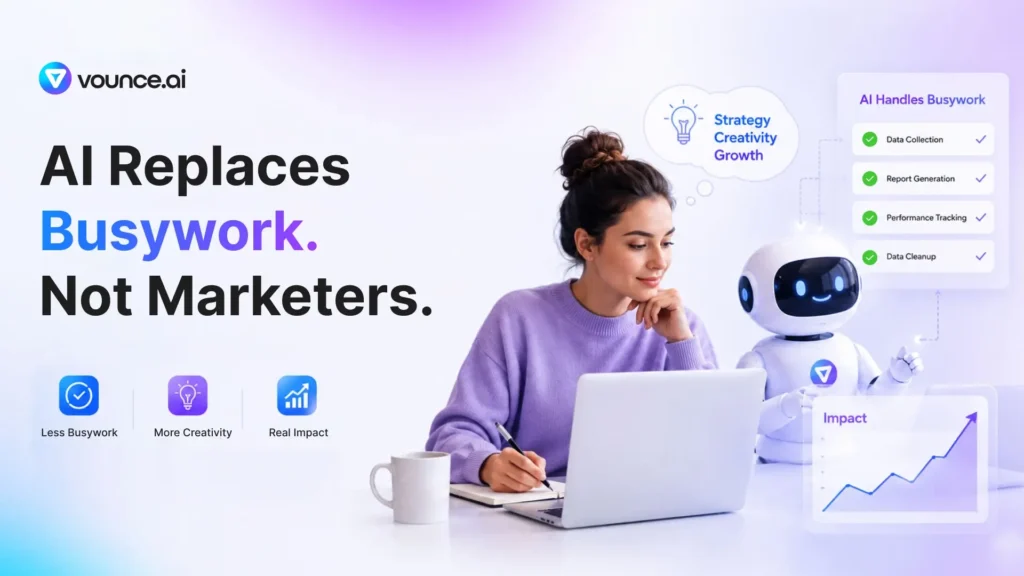
AI Won’t Replace Marketers. It Will Replace Slow Workflows
Summarize this blog with AI:
Table of Contents
- The question on everyone’s mind
- It’s not an AI vs. marketers war!
- AI is the replacement of workflows— it’s not marketers!
- AI functions as a marketer’s assistant, helping them work faster.
- Campaign Planning
- Data Analysis
- Customer Personalization
- Marketing automation is in a whole new world!
- AI Workflow Automation Where It Makes the Most Impact.
- Content Operations
- Customer Journeys
- AI has enhanced marketing productivity.
- AI makes campaign automation smarter
- AI also boosts marketing efficiency within teams.
- The use of digital marketing automation is becoming commonplace.
- The advantages of AI in marketing operations
- Artificial Intelligence Can’t Replace It.
- Exploring the Future of AI in Digital Marketing.
- Best Practices for Adopting AI in Marketing
- Conclusion
- FAQs
For numerous campaigns, email was substituted for direct mail. The social media revolution has revolutionized customer engagement. Many repetitive tasks have been eliminated as a result of marketing automation. In today’s day and age, AI is leading the way to the next big revolution.
However, there is one thing that keeps them abuzz:
The question on everyone’s mind: “Will AI replace marketers?”
The truth isn’t as grim as it sounds—it’s actually far more fascinating.
AI isn’t taking the place of creativity, strategy, and human decisions. It’s taking the place of time-consuming repetitive processes. Marketers no longer have to waste hours building reports, drafting initial pieces of content, campaign planning, or spreadsheet analysis since they can now concentrate on the work that actually generates business value.
It’s not an AI vs. marketers war!
It’s the marketers using AI that are succeeding over those who aren’t.
Let’s dive into the use of AI for marketers, why marketing automation is evolving into a more sophisticated tool, and how companies can speed up and improve marketing teams without compromising on creativity.
Marketing teams are feeling slower than ever because…
Today’s marketers are blessed with a lot more technology than previous generations.
Unfortunately, more tools don’t necessarily lead to more productivity.
There are still many marketing teams around that spend their day:
- Copying data from one platform to another
- An asset that is used repeatedly in a campaign.
- Creating reports manually
- Scheduling content
- Building landing pages
- Managing spreadsheets
- Coordinating approvals
- Updating CRMs
- Tracking campaign performance
These tasks are important.
But they do not need to be created by the sort of creative abilities that are uniquely human.
It’s here that AI in marketing takes the greatest effect.
AI doesn’t replace marketers; it eliminates repetitive tasks that can be found around marketing.
AI is the replacement of workflows— it’s not marketers!
Many people have the false impression that AI is taking the place of jobs.
In fact, AI replaces processes, not people.
Let’s take a look at a typical campaign launch.
A marketer without AI could go through the process in multiple days:
- Researching competitors
- Creating several different ads with different variations
- Creating landing page copy.
- Designing campaign emails
- Coming up with relevant social media content ideas.
- Generating reports
- Scheduling campaigns
- Updating dashboards
With modern AI marketing tools, a lot of this could be accomplished in mere minutes as opposed to days.
But it’s up to the marketer to make the choice:
- Campaign goals
- Target audience
- Brand messaging
- Creative direction
- Budget allocation
- Optimization strategy
So, AI doesn’t reduce the importance of marketers work—it speeds up execution.
This is why the conversation is shifting towards thinking about how AI will replace processes and not jobs—in this case, marketers.
AI functions as a marketer’s assistant, helping them work faster.
Automating repetitive tasks boosts speed dramatically, which is why businesses that are implementing AI are experiencing improvements.
Let’s explore how AI assists marketers in getting more done in their everyday operations.
Content Creation
AI can generate:
- Blog outlines
- Email drafts
- Ad copy
- Product descriptions
- Headlines
- Meta descriptions
- Social captions
Marketers don’t start from scratch but rather build off of a strong first draft.
Campaign Planning
AI assists with:
- Audience segmentation
- Keyword research
- Campaign ideas
- Creative concepts
- Content calendars
Previously, planning required hours of research; now it takes much less.
Data Analysis
Campaign metrics are time-consuming to gather for marketing teams.
AI automatically:
- Summarizes reports
- Highlights trends
- Detects anomalies
- Recommends optimizations
- Forecasts performance
This saves marketers time in data collection and enables them to focus on action.
Customer Personalization
With modern AI, personalization can be achieved at scale.
Examples include:
- Personalized emails
- Product recommendations
- Dynamic landing pages
- Customer segmentation
- Personalized messaging
This improves the customer experience and increases conversion rates.
In the future, artificial intelligence marketing tools will be used as marketing assistants.
New AI marketing technologies are more than just automation.
AI is no longer used to complete a single task but now facilitates a whole workflow.
Examples include:
- Campaign planning
- Copywriting
- Image generation
- Landing page creation
- SEO recommendations
- Email optimization
- Lead scoring
- Customer support
- Analytics
AI does not take the place of marketers, instead it is a very efficient assistant that never gets tired at work.
The marketer is still responsible for strategy.
AI accelerates execution.
Marketing automation is in a whole new world!
Traditional marketing automation was based on the fundamentals.
Examples included:
If a customer opens up an e-mail, send another e-mail.
In today’s context, automation is far more intelligent with AI technology.
Modern systems can:
- Predict customer behavior
- Suggest when and how to send campaigns.
- Personalize campaigns automatically
- Generate content dynamically
- Optimize ad budgets
- Identify high-converting audiences
That’s why marketing automation using AI is transforming from a mere function to a competitive edge.
AI Workflow Automation Where It Makes the Most Impact.
AI doesn’t benefit all marketing activities equally.
If a task is repetitive, it’s an ideal candidate for automation.
AI can automate:
- Asset creation
- Campaign setup
- Scheduling
- Testing
- Reporting
Campaigns launch faster and have much fewer manual steps.
Content Operations
AI greatly speeds up:
- Blog production
- Email campaigns
- Social media
- Product marketing
- SEO optimization
This is one of the most valuable use cases of AI content generation for marketing teams.
Several hours per week are spent on weekly reporting.
AI now:
- Pulls analytics automatically
- Builds dashboards
- Summarizes insights
- Identifies trends
- Creates executive reports
Marketers use reports, rather than building them.
Customer Journeys
AI improves:
- Lead nurturing
- Customer segmentation
- Lifecycle marketing
- Personalization
- Recommendation engines
These enhancements help improve customer satisfaction and profits.
AI has enhanced marketing productivity.
In marketing, AI’s biggest advantage is the productivity it brings.
Consider the difference.
Without AI:
Spend 5 hours creating content.
Spend 3 hours on reporting.
Spend 2 hours managing campaigns.
Spend 4 hours reviewing campaign data.
With AI:
- Generate the first draft in minutes.
- Automated reporting
- Instant campaign summaries
- Faster analysis
- Smarter recommendations
With the time saved, marketers can focus on:
- Strategy
- Customer research
- Brand positioning
- Creative thinking
- Experimentation
These are places where human beings can outdo the machines with their consistent performance.
AI makes campaign automation smarter.
Traditional campaign automation was based on predefined rules.
AI introduces intelligence.
AI can do more than just follow instructions; it can:
- Predict conversions
- Optimize audiences
- Recommend budgets
- Improve messaging
- Optimize high-performing and underperforming campaigns.
Marketers no longer have to manage every task manually; campaigns improve over time.
AI also boosts marketing efficiency within teams.
Marketing is not typically a stand-alone activity.
Teams collaborate with:
- Sales
- Product
- Design
- Customer success
- Leadership
Instead of handling these tasks manually, AI streamlines collaboration between departments by automatically:
- Sharing updates
- Summarizing meetings
- Tracking project progress
- Creating documentation
- Generating reports
This results in greater marketing efficiency, fewer delays, and better collaboration.
The use of digital marketing automation is becoming commonplace.
In modern businesses, digital marketing automation is used across almost every customer touchpoint.
Common examples include:
- Automated email campaigns
- AI chatbots
- Dynamic landing pages
- Predictive lead scoring
- Smart advertising
- Personalized recommendations
- AI-powered analytics
Automation doesn’t replace your marketing team; it helps your team scale without significantly increasing headcount.
The advantages of AI in marketing operations are numerous, with some of the most notable ones being the following:
AI isn’t just about saving time in marketing operations—it’s about transforming them.
Organizations commonly experience:
Faster Campaign Launches
The production time is greatly shortened by AI, enabling companies to capitalize on market opportunities in a timely fashion.
Higher Quality Decisions
AI can analyze much larger volumes of data than humans, leading to better optimization.
Greater Consistency
AI can smooth out the messaging of brands across channels.
Better Personalization
Content is more targeted and timely to customers.
Lower Operational Costs
Automation saves time by handling repetitive tasks and boosting productivity.
Improved Team Satisfaction
Marketers have more time to dedicate to significant and creative projects and less time on administrative ones.
Artificial Intelligence Can’t Replace It.
While there have been significant strides, there are also some limitations to AI.
It cannot replace:
- Human creativity
- Emotional intelligence
- Brand storytelling
- Strategic planning
- Customer empathy
- Cultural understanding
- Relationship building
- Ethical decision-making
The most effective marketing campaigns are still ones that are driven by people and powered by AI.
Hence, AI is not viewed as a replacement or a solution but a collaborator, which is why successful recognize it as such.
Exploring the Future of AI in Digital Marketing.
Intelligent collaboration is the key area of focus for AI in digital marketing.
In the coming years, AI will become even better at:
- Predicting customer intent
- Creating personalized experiences
- Optimizing campaigns ‘on the fly’
- Automating repetitive workflows
- Supporting strategic decisions
- Enhancing creative production
Marketers won’t disappear.
Their roles will continue to evolve.
Software management will become less time-consuming.
More time will be dedicated to a better understanding of customers, better experiences, and increased business growth.
Best Practices for Adopting AI in Marketing
In order to get the best results, organizations should:
Identify repetitive tasks first, then automate them.
Keep humans in control of strategy and creativity.
Beware of content generated by AI; always review before publishing.
Opt for AI tools that can fit into your existing processes.
Educate the marketing team on using AI to enhance their performance.
Regularly measure productivity improvement.
Regularly fine-tune automated workflows.
It’s not to take the place of marketers.
It’s to get rid of the hindrances that slow them down.
Conclusion
The question isn’t whether AI will replace marketers—it’s how marketers will use AI to work more effectively.
So the key issue is whether marketers will accept AI to get rid of the ineffective workflows.
In today’s highly successful teams, AI is employed to automate tedious tasks for marketers, optimize marketing automation, rapidly streamline AI workflow automation, and drive better decisions with creativity intact.
As AI in marketing continues to evolve, the biggest competitive advantage won’t come from having the most AI tools.
It will belong to companies that combine human expertise with smart automation to work faster, smarter, and more efficiently.
// FAQs
Frequently Asked Questions
AI for marketers is about using AI to automate repetitive tasks, analyze data, and improve campaign performance.
The fact that AI has arrived does not mean that it is replacing slow processes. Marketers still take charge of strategy, creativity, and decision-making.
By automating repetitive tasks, AI enables marketers to focus on higher-value work.
AI improves efficiency, speeds up processes, enhances personalization, and reduces manual work.
Marketers can start by using AI for repetitive tasks such as content drafting, campaign planning, data analysis, reporting, and marketing automation, allowing them to focus on strategy and creativity.