What Is a Marketing Funnel? Stages, Examples, Metrics & Optimization
Summarize this blog with AI:
TL;DR
A marketing funnel describes how people move from discovering your business to considering your offer and eventually becoming customers. It helps you understand what potential buyers need at each stage, where they lose interest, and what your team can do to move them forward.
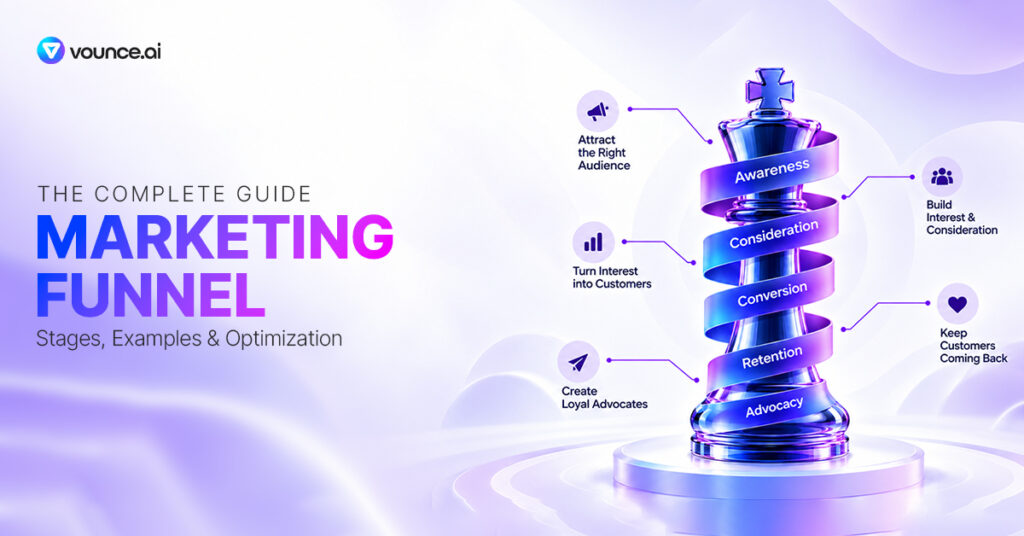
A practical marketing funnel includes:
- Awareness: Help potential customers discover your brand.
- Consideration: Give interested prospects reasons to evaluate your solution.
- Conversion: Make it easier for qualified prospects to take the next step.
- Retention: Keep customers engaged after the purchase.
- Advocacy: Encourage satisfied customers to recommend your business.
The most effective funnels connect the right audience, relevant content, a clear next step, and consistent measurement. More traffic alone will not fix a funnel that attracts the wrong people or makes it difficult for interested prospects to convert.
Table of Contents
- What Is a Marketing Funnel, and Why Does It Matter?
- What Are the Stages of a Marketing Funnel?
- TOFU vs. MOFU vs. BOFU: What Content Moves Buyers Through Your Marketing Funnel?
- Getting Leads but No Customers? Here’s Where Your Funnel May Be Failing
- What Does a Marketing Funnel Look Like? Examples for Different Businesses
- How Do You Build a Marketing Funnel From Scratch?
- Marketing Funnel vs. Sales Funnel: Are They the Same?
- Which Marketing Funnel Metrics Should You Track?
- How Can You Optimize Your Marketing Funnel for More Conversions?
- What Marketing Funnel Mistakes Are Costing You Customers?
- Conclusion
- Frequently Asked Questions
1. What Is a Marketing Funnel, and Why Does It Matter?
A marketing funnel is a model that explains how potential customers move from first discovering a business to considering its products or services and taking action. It helps marketing teams understand what people need at different stages of their buying journey and how to guide them toward a purchase.
Think about the last time you bought something unfamiliar. You probably didn’t discover a brand and immediately purchase its product. You looked for information, compared options, checked reviews, and decided whether the product was worth your money.
Your customers do much the same thing.
Some people are only beginning to understand a problem. Others already know what they need but are comparing providers. A smaller group may be ready to buy and simply needs reassurance that your business is the right choice.
A marketing funnel helps you serve these different audiences instead of showing everyone the same message.
How does a marketing funnel turn strangers into customers?
The funnel represents the progression from a broad audience to people who are increasingly interested in your offer.
For example, a SaaS company might attract 10,000 visitors through search content. Some read a guide about a problem they are experiencing. A smaller group explores the product, some sign up for a trial, and a portion eventually become paying customers.
The audience gets smaller at each stage because not everyone has the same problem, budget, timing, or level of interest.
That isn’t necessarily a problem. The goal isn’t to convert every visitor. It’s to help the right people move forward.
Why do some businesses get traffic but struggle to generate leads?
Traffic tells you that people are arriving. It doesn’t tell you whether they’re the right people, whether your message matches their expectations, or whether they know what to do next.
A visitor might find an informative blog post but have no reason to explore your product. Someone arriving from a paid ad might expect a specific offer but land on a generic page. Another prospect may be interested but abandon a long form.
These are different problems, and each needs a different solution.
A marketing funnel gives you a way to investigate them stage by stage rather than treating low conversions as a single marketing problem.
Does every customer follow the same marketing funnel?
No. Some buyers make decisions in minutes, while others need weeks of research, internal approvals, demonstrations, and budget discussions.
A consumer buying a low-cost product may follow a relatively short journey. An enterprise buyer evaluating software may involve several stakeholders before making a decision.
Treat the funnel as a useful model, not a strict sequence that every customer must follow. People can skip stages, revisit earlier ones, or discover your brand through several channels before converting.
2. What Are the Stages of a Marketing Funnel?
A marketing funnel is commonly described using three stages: awareness, consideration, and conversion. Many businesses extend the model to include retention and advocacy because the customer relationship doesn’t end at the first purchase.
Here’s what each stage means and what your team should focus on.
Awareness: How do potential customers discover your business?
At the awareness stage, people are discovering your brand, researching a problem, or trying to understand whether a solution exists.
They may not know your company yet. They might not even know which product category can solve their problem.
Your goal is to attract relevant attention and help them understand the issue.
Useful tactics include:
- Educational blog posts and search-optimized guides
- Social media content that explains common challenges
- Paid campaigns aimed at relevant audiences
- Videos, reports, and industry resources
- Expert insights that answer early research questions
For example, a marketing team struggling to launch campaigns quickly might search for ways to reduce production delays. An article explaining campaign bottlenecks could introduce that team to a potential solution without pushing for an immediate purchase.
Measure: Relevant website traffic, engagement with educational content, branded search growth, and visits from your target audience.
Consideration: How do you turn interest into genuine leads?
At this stage, prospects understand their problem and are evaluating possible solutions. They’re asking which approach is right for them and which providers deserve their attention.
Your content should help them make an informed decision.
Useful tactics include:
- Product comparisons and alternatives pages
- Case studies and customer stories
- Webinars and detailed guides
- Product walkthroughs
- Email nurturing sequences
- Free trials, assessments, or other relevant offers
For example, someone researching landing page software may compare integrations, publishing options, testing capabilities, ease of use, and pricing before deciding which products to try.
Measure: Qualified leads, repeat visits, comparison-page engagement, demo requests, and trial sign-ups.
Conversion: What makes a lead finally become a customer?
At the conversion stage, prospects are close to taking action. They may need a final demonstration, a clear pricing explanation, customer proof, or confidence that the product meets their requirements.
Your job is to remove unnecessary uncertainty and friction.
Useful tactics include:
- Clear pricing and product information
- Personalized demos
- Relevant testimonials and case studies
- Straightforward checkout or sign-up processes
- Follow-up with prospects who have requested more information
- Landing pages aligned with the offer that brought visitors there
For example, a prospect who clicks an ad for a specific software trial should arrive on a page that explains that trial, its benefits, and how to start. Sending them to a generic homepage may create an unnecessary detour.
Measure: Lead-to-customer conversion rate, trial-to-paid conversion rate, cost per acquisition, and revenue generated.
Retention: How do you get customers to come back?
Winning a customer is only part of the job. Retention focuses on helping customers get value from what they purchased so they continue using it, renew their subscriptions, or make repeat purchases.
Depending on your business, tactics might include onboarding emails, product education, customer support, usage-based communication, loyalty programs, and relevant product recommendations.
Measure: Repeat purchase rate, renewal rate, churn, customer lifetime value, and product adoption.
Advocacy: Can existing customers help you find new ones?
Satisfied customers can become a source of new business through referrals, reviews, testimonials, and recommendations.
Advocacy works best when customers have experienced genuine value. Asking for a review immediately after someone signs up, before they’ve had time to see results, may be premature.
Measure: Referral leads, customer reviews, referral-to-customer conversion, and revenue from referrals.
3. TOFU vs. MOFU vs. BOFU: What Content Moves Buyers Through Your Marketing Funnel?
TOFU, MOFU, and BOFU are shorthand for the top, middle, and bottom of the funnel. These terms are especially common in content marketing, B2B marketing, and demand generation.
The important distinction is not just where someone sits in the funnel. It’s what they’re trying to accomplish and what information will help them take the next step.
TOFU: How do you attract people who don’t know your brand yet?
TOFU (Top of Funnel) content is designed for people who are discovering a problem, exploring a topic, or learning about possible solutions.
They may not be ready to compare products, so an aggressive sales message can feel out of place.
Content that works well includes:
- Educational blog posts
- Beginner’s guides and explainers
- Industry reports and research
- Informative videos and social posts
- Checklists that help people understand a problem
For example, a person searching for “why are my website visitors not converting?” may benefit from a guide explaining common conversion problems before they need a product recommendation.
The goal is to attract relevant readers and build trust, not to force every visitor into a demo.
MOFU: How do you turn interested prospects into qualified leads?
MOFU (Middle of Funnel) content serves people who understand their problem and are researching possible approaches.
They may be comparing methods, assessing the impact of the problem, or learning which criteria matter when choosing a solution.
Useful content includes:
- Detailed how-to guides
- Webinars and expert resources
- Solution comparisons
- Case studies
- Email sequences that answer common concerns
- Product education that demonstrates relevant capabilities
Imagine a marketing manager who has already decided to improve landing page performance. A comparison of different testing approaches or a case study showing how a team improved its workflow can help them evaluate their options.
The goal is to build confidence and help qualified prospects continue their research.
BOFU: What helps buyers choose your product or service?
BOFU (Bottom of Funnel) content is intended for prospects who are evaluating specific providers or preparing to make a decision.
They need concrete information that helps them assess fit, risk, cost, and expected value.
Useful content includes:
- Product demonstrations
- Pricing and plan comparisons
- Customer testimonials
- Detailed case studies
- Free trials or consultations
- Implementation details and answers to final objections
For example, a team evaluating an AI landing page platform may want to see how page creation, publishing, testing, and analytics fit into its existing workflow. A focused product demo can answer those questions more effectively than another introductory article.
The goal is to make the next step clear and reduce uncertainty.
Which content works best at each stage?
| Funnel stage | What the audience needs | Content examples | Possible next step |
| TOFU | Understand a problem | Guides, blogs, videos, reports | Read a related resource |
| MOFU | Evaluate solutions | Webinars, comparisons, case studies | Explore a solution or sign up |
| BOFU | Make a confident decision | Demos, pricing, testimonials, trials | Start a trial or purchase |
| Retention | Get more value | Tutorials, onboarding, customer education | Adopt a feature or renew |
| Advocacy | Share a positive experience | Referral programs, review requests | Recommend the business |
These stages are guidelines rather than fixed rules. A case study can introduce a new audience to a brand, while a blog post can help an existing prospect resolve a final concern.
How do you match content to search intent and buyer readiness?
Start by asking what someone is likely trying to accomplish with a search.
A query such as “what is a marketing funnel” suggests a need for an explanation. “Marketing funnel examples” suggests that the reader wants to see how the concept works in practice. “Marketing funnel software” suggests that the reader may be evaluating tools.
The content should match that purpose.
If someone wants examples, give them examples rather than a long product pitch. If someone is comparing software, provide meaningful comparison criteria and practical product information.
This alignment makes the experience more useful and gives readers a logical next step.
4. Getting Leads but No Customers? Here’s Where Your Funnel May Be Failing
If your business generates leads but sales remain slow, the problem may not be the number of leads you’re attracting. It could be what happens after they arrive.
The following checks can help you identify where potential customers are losing interest.
Why are people visiting your website but not filling out forms?
First, check whether the page matches the visitor’s expectations.
A visitor arriving from an ad about a particular offer should be able to find that offer immediately. If the headline is vague, the page explains too many unrelated things, or the next step is unclear, visitors may leave.
Review these areas:
- Does the headline match the campaign or search query?
- Is the value of the offer easy to understand?
- Is the main call to action visible and specific?
- Does the form ask only for information you genuinely need?
- Does the page provide enough evidence to build trust?
Your form matters, but it isn’t the only factor. A short form cannot compensate for an unclear offer or a poor match between the visitor’s intent and the page.
Why are you getting leads that never turn into sales?
Some leads are curious but not qualified. Others may be interested but aren’t ready to buy, while some may never have been a good fit for your product.
Look at the sources and characteristics of leads that become customers compared with those that don’t.
Are certain campaigns generating lots of sign-ups but few sales opportunities? Are leads missing a necessary budget, use case, or level of authority? Are sales teams contacting qualified prospects quickly enough?
This analysis helps you improve targeting and follow-up instead of simply trying to generate more leads.
Are you attracting the wrong audience?
A campaign can generate impressive traffic while reaching people who will never buy your product.
Review the search terms, audience targeting, ad messaging, and content topics responsible for your traffic. Compare them with the problems your ideal customers actually need to solve.
Broad reach is useful when it attracts relevant people. If it mostly brings visitors with unrelated needs, more traffic may increase costs without improving revenue.
Where are potential customers dropping out of your funnel?
Map the journey from first visit to purchase and measure the conversion between each meaningful step.
For example:
- Ad click to landing page visit
- Landing page visit to lead submission
- Lead submission to qualified opportunity
- Qualified opportunity to demo or trial
- Demo or trial to paid customer
A large drop between two stages gives you a place to investigate. It doesn’t automatically tell you why people are leaving, so combine the numbers with form analytics, customer feedback, sales notes, and user behavior where available.
How can you find and fix conversion gaps?
Choose the weakest meaningful stage and investigate it before changing everything at once.
If the landing page isn’t converting, test the message, offer, layout, or form. If leads aren’t becoming opportunities, examine targeting and qualification. If opportunities aren’t closing, review objections, sales follow-up, pricing, and product fit.
Make one clearly defined change, measure its impact, and document what you learn.
That gives your team a more reliable path to improvement than making several changes without knowing which one helped.
5. What Does a Marketing Funnel Look Like? Examples for Different Businesses
The basic funnel model can work across industries, but the content, channels, and conversion events should reflect how customers actually buy.
What is a marketing funnel example for a SaaS business?
Imagine a SaaS company selling project collaboration software.
- Awareness: A potential customer finds a blog post about reducing delays in team projects.
- Consideration: They download a practical checklist or explore a guide to collaboration workflows.
- Evaluation: They review product features, integrations, pricing, and customer stories.
- Conversion: They start a trial or book a product demonstration.
- Retention: Onboarding and product education help them adopt the software.
- Advocacy: A successful customer recommends the tool to another team.
The important part is the connection between each step. A visitor reading a general productivity article may need education first, while a visitor comparing collaboration platforms may be ready for a product-focused page.
How does a B2B lead generation funnel work?
B2B buying often involves longer decision cycles and multiple stakeholders.
A potential buyer might discover a business through search, attend a webinar, download a report, and later request a consultation. The sales team may then need to establish requirements, demonstrate the product, address objections, and support internal approval.
A useful B2B funnel combines relevant educational content with lead qualification, timely follow-up, and sales enablement.
The objective isn’t to collect as many email addresses as possible. It’s to identify organizations with a real need and help them evaluate the solution.
What does an e-commerce marketing funnel look like?
An e-commerce funnel often focuses on helping customers discover a product, evaluate it, and complete a purchase.
- Awareness: A shopper discovers a product through search, social media, or advertising.
- Consideration: They explore product pages, images, specifications, reviews, and comparisons.
- Conversion: They add the product to their cart and complete checkout.
- Retention: Follow-up communication, customer support, and relevant recommendations encourage repeat purchases.
- Advocacy: Satisfied customers leave reviews or recommend the product.
Common friction points include unexpected shipping costs, confusing product information, limited payment options, and a complicated checkout process.
How can a small business build a simple marketing funnel?
A small business doesn’t need a complicated automation system to get started.
A local service provider could publish a useful guide answering a common customer question, direct readers to a service page, offer a consultation request form, and follow up with relevant enquiries.
The business can then track how many enquiries become appointments and how many appointments turn into paying customers.
Start with the few steps that matter most. Add more tools and automation when there’s a clear reason to do so.
6. How Do You Build a Marketing Funnel From Scratch?
You don’t need to map every possible customer interaction before launching a funnel. Start with a clear audience, a relevant offer, and a way to measure whether people move forward.
Step 1: Who are you trying to attract?
Define the people most likely to benefit from your product or service.
Consider their goals, challenges, buying constraints, and the circumstances that cause them to search for a solution. A specific audience definition makes it easier to choose useful topics, channels, and offers.
Step 2: What problem makes someone start looking for a solution?
Identify the problem that prompts people to research your category.
Talk to customers, review sales conversations, examine support questions, and look at the language people use to describe their challenges.
Build your messaging around those needs instead of starting with a list of product features.
Step 3: Which marketing channels will reach your audience?
Choose channels based on how your audience discovers information and evaluates solutions.
Search content may work well for people actively researching a problem. Paid advertising can help you reach defined audiences or promote a specific offer. Email can nurture people who have already shown interest.
You don’t need to use every channel. Choose the ones you can execute consistently and measure properly.
Step 4: What will move prospects from interest to action?
Give visitors a logical next step that fits their level of interest.
Someone reading an introductory article might benefit from a related guide. Someone comparing products may want a case study, feature breakdown, or demonstration. A prospect ready to buy needs a straightforward path to purchase or sign-up.
Avoid asking every visitor to take the same action regardless of their needs.
Step 5: How will you capture and follow up with leads?
If your business depends on leads, decide which information you need to collect and how you’ll follow up.
Keep forms proportionate to the value of the offer. Define who receives new enquiries, how quickly they should be contacted, and how you’ll track their progress.
Use a CRM or another suitable system when manual tracking makes it difficult to maintain visibility.
Step 6: How will you turn interested leads into customers?
Give prospects the information and support they need to make a decision.
That might mean sending a relevant case study, answering product questions, arranging a demonstration, or explaining implementation and pricing. For simpler purchases, a clear product page and checkout may be enough.
Make sure the handoff between marketing and sales doesn’t leave interested prospects waiting without useful information.
Step 7: How will you measure whether the funnel is working?
Choose a small set of metrics that connect marketing activity to business outcomes.
Track the movement from visitors to leads, leads to qualified opportunities, and opportunities to customers. Where relevant, also measure acquisition costs, revenue, retention, and customer lifetime value.
Use these results to identify the stage that needs attention and decide what to test next.
7. Marketing Funnel vs. Sales Funnel: Are They the Same?
Marketing funnels and sales funnels are closely related, but they focus on different parts of the customer journey.
A marketing funnel focuses on attracting the right audience, building awareness, generating interest, and helping potential buyers evaluate a solution.
A sales funnel focuses on moving potential buyers through qualification, conversations, demonstrations, proposals, negotiations, and closing, depending on the business model.
| Marketing funnel | Sales funnel |
| Attracts and educates potential buyers | Evaluates and progresses sales opportunities |
| Uses content, advertising, events, and nurturing | Uses qualification, meetings, demos, proposals, and follow-up |
| Measures traffic, engagement, leads, and marketing-sourced opportunities | Measures opportunities, win rate, sales cycle, and closed revenue |
| Helps create demand and buying interest | Helps turn qualified interest into revenue |
Where does the marketing funnel end and the sales funnel begin?
There isn’t one universal handoff point. For a self-serve product, a visitor may move directly from marketing content to a free trial and purchase. In enterprise sales, marketing may nurture an account for months before a sales representative becomes involved.
The important thing is to agree on what makes a lead qualified, when sales should follow up, and how both teams will share feedback.
How can marketing and sales work together to close more deals?
Agree on lead qualification criteria, share information about customer objections, and review conversion rates across the entire journey.
Marketing can use sales feedback to improve campaigns and content. Sales can use marketing resources to answer buyer questions and support conversations.
When both teams focus on qualified opportunities and revenue rather than isolated activity metrics, it’s easier to identify where the customer journey needs improvement.
8. Which Marketing Funnel Metrics Should You Track?
You don’t need to measure every possible interaction. Start with metrics that reveal whether the funnel is attracting relevant people, generating qualified interest, and producing customers at a sustainable cost.
Are you measuring traffic or the quality of that traffic?
Traffic is useful for understanding reach, but it doesn’t tell you whether visitors match your target audience or take meaningful action.
Look at traffic sources alongside engagement, lead quality, and downstream conversion. A smaller group of highly relevant visitors may generate more revenue than a much larger audience with little buying intent.
How do you calculate marketing funnel conversion rates?
A conversion rate measures the percentage of people who complete a defined action out of the people who had the opportunity to complete it.
For example, if 1,000 people visit a landing page and 50 submit the form, the page’s visitor-to-lead conversion rate is 5%.
Be consistent about your denominator. A landing page conversion rate and a lead-to-customer conversion rate measure different things and should not be compared as though they are interchangeable.
What is a good lead-to-customer conversion rate?
There isn’t one universal benchmark that works for every business. Conversion rates vary by industry, price, audience, sales cycle, lead source, and what counts as a qualified lead.
Instead of relying on a generic target, establish your baseline and compare performance across campaigns, audience segments, and time periods. Also look at whether changes in lead volume affect lead quality and customer acquisition costs.
How do you measure cost per lead and customer acquisition cost?
Cost per lead (CPL) shows how much you spend to generate a lead.
CPL = Lead Generation Spend ÷ Number of Leads
Customer acquisition cost (CAC) measures the cost of acquiring customers. Depending on your reporting model, it may include advertising, marketing salaries, sales costs, tools, and other acquisition expenses.
CAC = Total Acquisition Costs ÷ New Customers Acquired
Define which costs you’re including before comparing results. A low CPL isn’t necessarily a win if those leads rarely become customers.
Which metrics matter most at each funnel stage?
| Stage | Metrics to consider | What they help you understand |
| Awareness | Relevant traffic, reach, engagement | Whether you’re attracting the intended audience |
| Consideration | Qualified leads, repeat visits, content engagement | Whether interest is developing |
| Conversion | Lead-to-customer rate, win rate, CAC | Whether interest is turning into revenue |
| Retention | Renewal, churn, repeat purchase rate | Whether customers continue to find value |
| Advocacy | Referrals, reviews, referral revenue | Whether customers help attract new business |
How can you identify where your funnel is losing revenue?
Review conversion between consecutive stages rather than looking only at the final result.
If traffic is increasing but qualified leads aren’t, revisit audience targeting and the relevance of your content. If qualified leads are healthy but few become customers, examine sales follow-up, objections, pricing, and product fit.
The numbers identify where to investigate. Customer feedback and behavior help explain why the problem is happening.
9. How Can You Optimize Your Marketing Funnel for More Conversions?
Once you understand how people move through your funnel, focus on removing the barriers that prevent them from taking the next step.
How can you improve landing page conversion rates?
Start with the promise that brought the visitor to the page.
Make the headline specific, explain the value of the offer, and use supporting information that addresses the audience’s concerns. Keep the primary call to action easy to identify and remove distractions that don’t support the intended action.
If you’re running several campaigns, make sure each page reflects the relevant audience, message, and offer.
For teams managing many campaigns, the production process matters too. When every page requires extensive manual coordination, testing new messages and offers can become difficult. A streamlined workflow can help teams create, publish, and improve campaign pages more efficiently. Platforms such as Vounce are designed to support that process.
Are your lead forms asking for too much information?
Every additional field creates another decision for the visitor.
Ask for the information needed to deliver the offer or qualify the enquiry. Save less essential questions for a later conversation if possible.
However, shorter isn’t always better. A high-value consultation may justify asking more questions than a simple newsletter sign-up. The right form balances ease of completion with the information your team needs.
How can you follow up with leads before they lose interest?
Make follow-up timely, relevant, and connected to the action the person took.
Someone requesting a demo should receive the information needed to prepare for it. Someone downloading an introductory guide may benefit from related educational content before receiving a sales-oriented message.
Use automation to support consistent follow-up, but avoid sending repetitive messages that ignore a prospect’s interests or previous interactions.
Can A/B testing help you find what converts better?
A/B testing compares different versions of an experience to see which performs better against a defined goal.
You might test a headline, offer, call-to-action wording, form length, or page layout. Start with a clear hypothesis, choose one primary metric, and give the test enough relevant data to support a decision.
Avoid changing several major elements at once if you want to understand what caused the difference. Also consider lead quality and downstream outcomes, not just clicks or form submissions.
How can personalization make your marketing more relevant?
Personalization can make the experience more useful when it reflects meaningful differences in audience needs.
For example, visitors arriving from different campaigns may need different examples, messages, or offers. Returning prospects may need more detailed product information than first-time visitors.
Start with relevant differences you can support with reliable data. Personalization should clarify the experience, not create complexity for its own sake.
How do you get more customers without increasing ad spend?
Before raising the budget, examine the performance of your existing funnel.
Check whether your campaigns attract the right audience, whether landing pages deliver on the ad’s promise, whether leads receive timely follow-up, and whether prospects encounter avoidable friction before buying.
Improving one weak stage can help you get more value from the traffic and leads you already have. It won’t guarantee growth without additional spending, but it gives you a more informed starting point than simply buying more traffic.
10. What Marketing Funnel Mistakes Are Costing You Customers?
Even a well-planned funnel can underperform when the execution doesn’t reflect how customers make decisions.
Are you trying to sell before building trust?
Not every visitor is ready to purchase. Pushing a sales message at someone who is still trying to understand a problem may drive them away.
Match the offer to the visitor’s likely needs and provide useful information before asking for a bigger commitment.
Are you sending every visitor to the same landing page?
A generic destination can create a mismatch between a campaign promise and the page experience.
Where possible, align the page with the visitor’s source, audience, and offer. This doesn’t mean creating a separate page for every tiny audience segment. Prioritize differences that materially change what the visitor needs to see.
Are you focusing on lead volume instead of lead quality?
More leads can look impressive in a report, but the number matters less if few are relevant to your business.
Track qualified leads, opportunities, customers, and acquisition costs alongside raw lead volume. Use those results to identify which campaigns attract prospects who are likely to buy.
Are your marketing and sales teams working in silos?
When teams use different definitions of a qualified lead or fail to share feedback, promising prospects can fall through the cracks.
Agree on qualification criteria, follow-up expectations, and shared reporting. Regularly discuss why deals progress or stall so marketing can improve targeting and sales can better understand what prospects already know.
Are you ignoring what happens after the first conversion?
A purchase or sign-up is not the end of the customer journey.
If customers struggle with onboarding, fail to adopt the product, or don’t receive the expected value, they may not renew or recommend your business.
Include retention in your funnel planning so acquisition efforts support lasting customer relationships rather than one-time transactions.
11. Conclusion
Make Every Stage of Your Marketing Funnel Count
A marketing funnel gives your team a practical way to understand the journey from first discovery to customer loyalty. It helps you see whether you’re attracting the right audience, giving prospects useful information, making it easy to take action, and delivering value after the purchase.
You don’t need a complicated funnel to begin. Map the main steps your customers take, measure how people move between them, and focus on the biggest gap you can identify.
As your marketing grows, keep improving the connection between campaigns, content, landing pages, follow-up, and measurement. When these parts work together, your team can make better decisions about where to invest time and budget, and where the customer experience needs attention.
If campaign pages are one of the bottlenecks in your process, explore Vounce to see how you can build and launch landing pages, then test and optimize them as your campaigns evolve.
// FAQs
Frequently Asked Questions
A common five-stage model is awareness, consideration, conversion, retention, and advocacy. Awareness helps people discover your business; consideration supports evaluation; conversion turns prospects into customers; retention encourages continued value; and advocacy helps satisfied customers recommend your brand.
TOFU means top of funnel and focuses on awareness and education. MOFU means middle of funnel and helps interested prospects evaluate solutions. BOFU means bottom of funnel and supports purchase decisions through demonstrations, pricing information, testimonials, and other decision-stage content.
It depends on your product, price, audience, and sales process. A straightforward online purchase may happen quickly, while a B2B software purchase can involve several stakeholders and a longer evaluation. Track conversion time using your own customer data to understand the typical journey.
A marketing funnel focuses on attracting, educating, and nurturing potential buyers. A sales funnel focuses on progressing qualified opportunities toward a purchase. The two overlap and should share clear definitions, data, and handoff processes.
Start with a defined audience and a clear customer problem. Choose channels that reach that audience, create content and offers that match each stage, make the next step easy, and measure conversion between stages. Use those results to identify friction and test improvements.