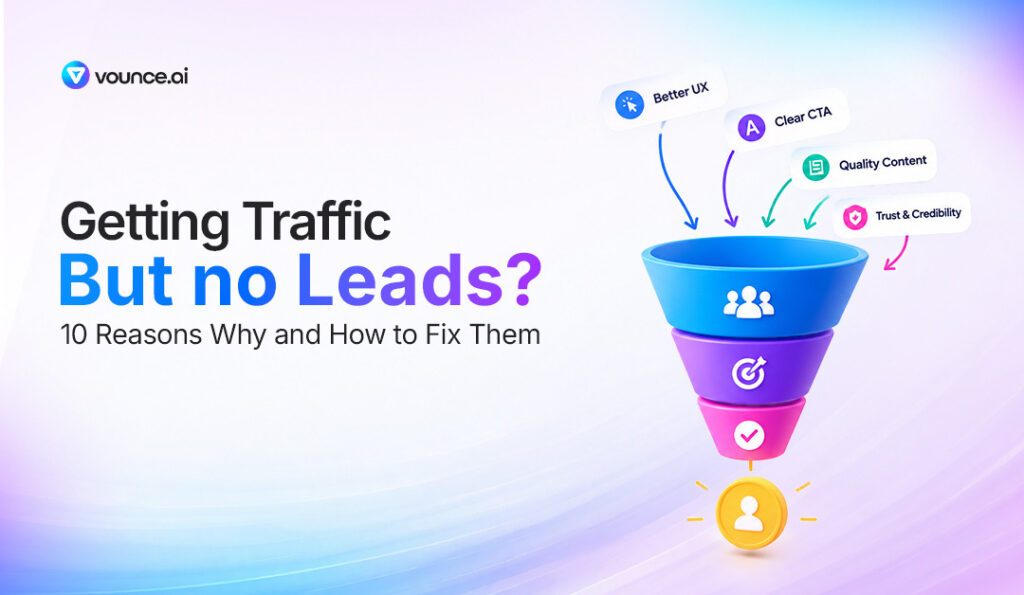
Getting Website Traffic but No Leads? 10 Reasons Why—and How to Fix Them
Summarize this blog with AI:
Getting people to your website is only half the job.
You can rank for keywords, run paid campaigns, publish content, and build a strong social presence—and still struggle to generate leads.
That’s one of the most frustrating situations for a marketing team:
More traffic → More visitors → Little or no increase in leads
When that happens, the obvious reaction is often to invest more in acquisition.
More ads.
More content.
More keywords.
More campaigns.
But what if the problem isn’t traffic?
What if the visitors you’re already attracting aren’t getting enough reason to take the next step?
They might not understand your offer. They might not see enough value. They might not trust the company yet. Or the process of becoming a lead might simply be harder than it needs to be.
This is where website conversion rate optimization becomes important.
Instead of asking only, “How do we get more traffic?”, ask:
“How do we turn more of our existing traffic into meaningful actions?”
TL;DR
If your website is getting traffic but generating few leads, the problem may not be traffic—it may be conversion. Your visitors might be the wrong audience, landing on pages that don’t match their intent, struggling to understand your value, or facing too much friction before taking action.
To improve conversions:
- Attract more relevant traffic, not just more traffic.
- Match your page and message to visitor intent.
- Make your value proposition clear within seconds.
- Build trust with proof, reviews, testimonials, and results.
- Remove unnecessary conversion friction from forms, navigation, and mobile experiences.
- Create stronger, intent-based offers and CTAs.
- Give different campaigns relevant landing experiences instead of sending everyone to the same page.
- Test changes using a hypothesis-driven CRO process.
- Measure leads, qualified leads, and revenue, not just traffic.
The key takeaway: you don’t always need more visitors—you may need to get more value from the visitors you already have.
Table of Contents
- What Does It Mean When Your Website Gets Traffic but No Leads?
- You’re Getting the Wrong Kind of Traffic
- Your Website Doesn’t Match Visitor Intent
- Your Value Proposition Isn’t Clear
- Visitors Don’t Trust Your Offer Yet
- There’s Too Much Conversion Friction
- Your Offer Isn’t Strong Enough
- Your CTA Doesn’t Give Visitors a Clear Next Step
- You’re Sending Every Campaign to the Same Experience
- You’re Not Testing What Actually Matters
- You’re Measuring Traffic Instead of Business Outcomes
- A Simple Website Conversion Audit
- Final Takeaway
- Frequently Asked Question
1. What Does It Mean When Your Website Gets Traffic but No Leads?
Before trying to improve your website conversion rate, define what a conversion actually means for your business.
For one company, a conversion might be a demo request. For another, it could be a free-trial signup, contact-form submission, consultation, newsletter signup, or purchase.
Common website conversion goals include:
- Demo requests
- Free-trial signups
- Contact forms
- Consultation bookings
- Newsletter subscriptions
- Quote requests
- Product purchases
- Resource downloads
Think of the journey as:
Traffic → Website → Engagement → Conversion → Lead → Customer
If traffic is increasing but leads aren’t, something between the first visit and the desired action may be breaking down.
A simple website conversion rate calculation is:
Conversion Rate = (Conversions ÷ Total Visitors) × 100
For example, if 10,000 visitors generate 200 leads:
200 ÷ 10,000 × 100 = 2%
But don’t assume that 2% is automatically good or bad.
Conversion rates vary depending on:
- Industry
- Traffic source
- Audience
- Offer
- Device
- Buying stage
- Conversion goal
A visitor searching for a specific software solution behaves very differently from someone reading an introductory blog post.
So instead of asking:
“What’s a good website conversion rate?”
start with:
“Is my website converting the visitors I’m attracting as effectively as it could?”
That’s the question that leads to useful optimization.
2. You’re Getting the Wrong Kind of Traffic
Not every visitor is a potential customer.
A website can receive thousands of visitors and still generate very few qualified leads because the traffic doesn’t match what the business offers.
Imagine a company selling project management software to marketing teams.
Someone searching:
“Best project management software for marketing teams”
has a very different intent from someone searching:
“What is project management?”
Both searches can generate website traffic.
But the first visitor is much closer to evaluating a solution.
That’s why traffic quality matters as much as traffic volume.
Look at your traffic by:
- Search query
- Traffic source
- Campaign
- Audience
- Geography
- Device
- New vs. returning visitors
- Landing page
- Conversion rate
Then compare those segments against the number and quality of leads they generate.
You may discover that your largest traffic source produces very few leads while a smaller source produces highly qualified prospects.
That’s not necessarily a traffic problem.
It’s a targeting problem.
How to fix it
Start identifying which sources bring visitors who actually engage and convert.
Then focus your acquisition strategy around those audiences and search intents.
For SEO, this means looking beyond search volume.
A keyword with 10,000 searches isn’t automatically more valuable than one with 500 searches if the smaller keyword attracts people who are much closer to needing your product.
The goal isn’t simply more visitors. It’s more relevant visitors.
3. Your Website Doesn’t Match Visitor Intent
Imagine someone clicks an advertisement promising:
Launch campaigns without waiting on developers.
They arrive on a generic homepage that says:
Powerful technology for modern businesses.
The second statement isn’t necessarily bad.
But there’s a disconnect.
The visitor expected to find information about launching campaigns faster. Instead, they now have to search through the website to understand whether they’ve arrived at the right place.
That’s a message-match problem.
A strong visitor journey feels connected:
Search Query → Ad → Page → Offer → Action
The message doesn’t have to be identical at every stage, but the visitor should feel that they’ve continued the same conversation.
How to fix it
Look at your highest-value traffic sources and ask:
What did this visitor expect when they clicked?
Then compare that expectation with the page they actually see.
For example:
Search:
“Landing page software for Google Ads”
Page:
A generic company homepage
That’s weak alignment.
A more relevant experience would immediately address:
- Google Ads campaigns
- Landing page creation
- Campaign-specific benefits
- Relevant examples
- A clear next step
This is especially important for paid campaigns.
When the promise that generates the click matches the experience that follows, visitors don’t have to work as hard to understand the relevance.
4. Your Value Proposition Isn’t Clear
Visitors shouldn’t have to investigate your website to figure out what you do.
Within seconds, they should be able to understand:
What is this?
Who is it for?
What problem does it solve?
Why should I care?
Compare:
Marketing software for modern businesses.
with:
Launch and test campaign pages without waiting on developers.
The second statement gives visitors a much clearer reason to continue.
A useful way to structure a value proposition is:
Problem → Solution → Outcome
For example:
Campaign launches taking too long? Create and publish conversion-focused experiences without adding another development task to your team’s queue.
The goal isn’t to explain every feature immediately.
It’s to establish relevance.
Once visitors understand the basic value, the rest of the page can answer deeper questions around:
- Features
- Benefits
- Pricing
- Implementation
- Proof
- Security
- Support
- Next steps
How to fix it
Write your value proposition as if you’re explaining the product to someone who has never heard of your company.
Avoid vague phrases such as:
- Innovative solutions
- Next-generation platform
- Powerful technology
- All-in-one solution
unless they’re supported by something specific.
Specificity makes value easier to understand.
 
5. Visitors Don’t Trust Your Offer Yet
Understanding your offer doesn’t automatically mean visitors will act.
They may still wonder:
“Does this actually work?”
“Can I trust this company?”
“Will this solve my problem?”
“What happens after I submit my information?”
This is where trust becomes a conversion factor.
Useful trust signals can include:
- Customer testimonials
- Reviews
- Case studies
- Customer logos
- Product screenshots
- Results
- Certifications
- Security information
- Transparent pricing
- Clear policies
But don’t add proof just because you saw it on another website.
Use proof that addresses the concerns your visitors actually have.
For example, if customers worry about implementation time, a case study showing how quickly another company adopted your product is more useful than a generic testimonial saying:
“Great product!”
How to fix it
Map your visitor’s biggest objections.
Then answer them throughout the experience.
Think of your page as gradually removing uncertainty:
What is it? → Does it work? → Is it right for me? → Can I trust you? → What happens next?
That progression can make the decision to convert feel much easier.
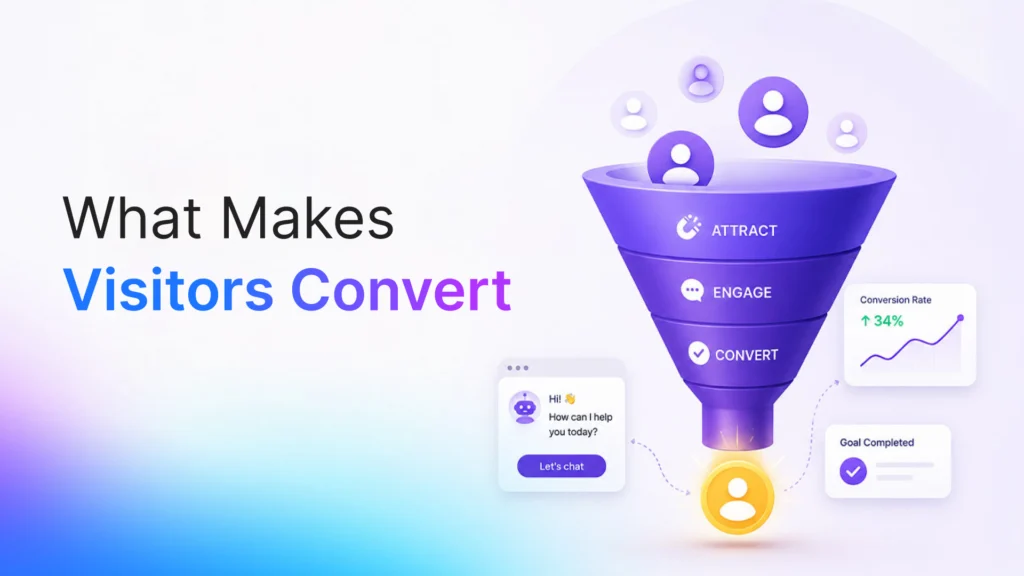
If you want to explore the psychological side of conversion behavior, Vounce’s guide on what makes visitors convert goes deeper into visitor motivation and decision-making.
6. There’s Too Much Conversion Friction
Sometimes visitors want to convert.
The problem is that the process makes it unnecessarily difficult.
This is known as conversion friction.
It can come from:
- Long forms
- Too many steps
- Confusing navigation
- Slow-loading pages
- Unclear pricing
- Too many choices
- Poor mobile usability
- Distracting pop-ups
- Unexpected requirements
Imagine a visitor wants to request a demo and encounters a form asking for ten different pieces of information.
Every unnecessary field creates another opportunity for abandonment.
But shorter isn’t always better.
Your sales team might genuinely need certain information to qualify a lead.
The better question is:
What information do we actually need at this stage?
The same applies to the rest of the experience.
If a visitor needs five clicks to reach something that could reasonably take one, you’ve introduced friction.
How to fix it
Look at the complete conversion path.
Ask:
- Can visitors understand what to do?
- Can they find the CTA quickly?
- Is the form asking for unnecessary information?
- Does the page load quickly?
- Does it work well on mobile?
- Are pop-ups interrupting the journey?
- Are there unnecessary steps between interest and action?
Good conversion optimization isn’t about removing everything.
It’s about removing unnecessary effort.
7. Your Offer Isn’t Strong Enough
Sometimes everything appears to be working.
The traffic is relevant.
The page is clear.
The design is good.
But visitors still aren’t converting.
The problem may be the offer itself.
Compare:
Contact Us
with:
Get a Free Campaign Performance Audit
The second gives visitors a more tangible reason to act.
Your offer should answer:
“Why should I take action right now?”
Depending on the business, that could be:
- Free trial
- Product demo
- Consultation
- Audit
- Assessment
- Template
- Checklist
- Calculator
- Report
- Case study
- Educational guide
The offer should also match the visitor’s buying stage.
Match the offer to intent
Low awareness:
Educational content
Problem aware:
Guide, checklist, audit, or resource
Solution aware:
Product information or demo
Purchase ready:
Trial, consultation, or purchase
A common mistake is asking every visitor for the same high-commitment action.
Someone reading an introductory article may not be ready to book a sales call.
Someone comparing products may be.
How to fix it
Think about the visitor’s intent before deciding what conversion you want.
The closer someone is to a buying decision, the more direct your offer can become.
8. Your CTA Doesn’t Give Visitors a Clear Next Step
A call to action is where you ask the visitor to move forward.
A button saying:
Submit
doesn’t tell the visitor much.
A clearer CTA could be:
- Start Free
- Book a Demo
- Get My Free Audit
- Build Your First Page
- Download the Guide
- Start Your Trial
The best CTA depends on your conversion goal.
But clarity usually matters more than cleverness.
If your primary goal is generating demo requests, that action should be more prominent than secondary actions such as following your social media accounts or browsing unrelated pages.
How to fix it
Make the desired next step obvious.
Visitors should understand:
What am I doing?
What will happen next?
Why should I do it?
A CTA doesn’t need to be aggressive.
It needs to reduce uncertainty.
For example:
Start Free — No Credit Card Required
can communicate both the action and an objection-removing detail.
The CTA itself isn’t the entire conversion strategy, but it should make the next step feel straightforward.
9. You’re Sending Every Campaign to the Same Experience
This becomes a bigger problem as marketing teams run more campaigns.
Imagine three campaigns:
Campaign A
Landing page software for SaaS teams
Campaign B
Launch campaigns without developers
Campaign C
Improve paid-traffic conversions
Each campaign has a different motivation.
But if every visitor is sent to the same generic homepage, each person has to find the information relevant to them.
Campaign-specific experiences can instead reflect:
- Campaign message
- Target audience
- Problem
- Offer
- Relevant proof
- CTA
This doesn’t mean building an entirely new website for every campaign.
It means making it easier to create relevant experiences quickly.
This becomes particularly important when campaign execution requires long handoffs between marketing, design, development, and deployment.
As we’ve discussed in The Campaign Launch Gap, the time between a campaign being planned and actually going live can become a hidden growth bottleneck.
For teams running frequent campaigns, reducing:
Idea → Page → Launch → Test
can make experimentation much easier.
Tools such as Vounce are designed around this workflow, helping marketing teams create and launch campaign experiences without turning every new page into a lengthy development project.
10. You’re Not Testing What Actually Matters
Your first version doesn’t need to be perfect.
What matters is having a process for learning.
This is where conversion rate optimization (CRO) becomes useful.
Instead of changing a page because someone thinks it “looks better,” identify a problem and create a hypothesis.
For example:
Hypothesis: Reducing the demo form from seven fields to four will increase submissions because visitors experience less friction.
Then test it.
You can experiment with:
- Headlines
- Offers
- CTAs
- Forms
- Page structure
- Social proof
- Images
- Pricing presentation
- Content length
- Layout
But avoid changing everything simultaneously.
If you change the headline, offer, CTA, form, design, and copy at the same time, you may improve performance—but you won’t know what caused the improvement.
A better process is:
Identify → Hypothesize → Test → Measure → Learn → Iterate
Use data to find what needs testing
Depending on your analytics setup, useful signals can include:
- High bounce or exit rates
- Low engagement
- Form abandonment
- Low CTA interaction
- Poor mobile performance
- Significant differences between traffic sources
- Drop-offs between steps
You can also use tools such as heatmaps and session recordings to understand how visitors interact with important pages.
The goal isn’t to run tests simply because you’re supposed to.
It’s to turn uncertainty into learning.
11. You’re Measuring Traffic Instead of Business Outcomes
Traffic is useful.
But traffic isn’t the final outcome.
Consider two websites.
Website A
100,000 visitors
1% conversion rate
1,000 leads
Website B
20,000 visitors
5% conversion rate
1,000 leads
Now imagine Website B improves its conversion rate from 5% to 6%.
20,000 visitors × 6% = 1,200 leads
The business gains 200 additional leads without acquiring another visitor.
That’s why conversion rate optimization deserves attention alongside traffic acquisition.
Don’t track only:
- Visitors
- Pageviews
- Sessions
Also track:
- Conversion rate
- Leads
- Qualified leads
- Demo bookings
- Trial signups
- Cost per lead
- Sales opportunities
- Customer acquisition cost
- Revenue
The exact metrics will depend on your business model.
But the principle is simple:
Traffic is an input. Business outcomes are the goal.
A traffic report can tell you that 50,000 people visited.
It doesn’t necessarily tell you whether those people were valuable.
12. A Simple Website Conversion Audit
You don’t need an expensive CRO program to start identifying opportunities.
Pick your most important page and work through this checklist.
| Question | What to Check |
| Is the traffic relevant? | Audience, source, search intent |
| Is the message clear? | What you offer and who it’s for |
| Does the page match the source? | Message match |
| Is the value obvious? | Benefits and outcomes |
| Is there enough trust? | Reviews, proof, testimonials |
| Is the offer compelling? | Reason to take action |
| Is the CTA clear? | Obvious next step |
| Is there unnecessary friction? | Forms, steps, distractions |
| Does it work well on mobile? | Usability and performance |
| Are you testing? | Hypotheses and experiments |
| Are you measuring outcomes? | Leads, qualified leads, revenue |
Don’t try to fix everything at once.
Prioritize the problem most likely to affect your results.
For example, if visitors leave almost immediately, changing the form at the bottom of the page probably isn’t the first priority.
If visitors engage with the page but abandon the form, reducing form friction may have a much bigger impact.
If one traffic source converts significantly better than another, the answer may lie in targeting and message match rather than page design.
Start with evidence, not assumptions.
13. Final Takeaway
Getting website traffic is important.
But traffic alone doesn’t create leads.
If your website is attracting visitors but not converting them, don’t automatically assume you need more traffic.
First, investigate what’s happening between the click and the conversion.
- Are you attracting the right audience?
- Does your website match visitor intent?
- Is your value proposition clear?
- Do visitors trust your offer?
- Is the conversion process unnecessarily difficult?
- Is the offer compelling?
- Is the next step obvious?
- And are you testing the changes you make?
The strongest growth strategy isn’t always:
Get more traffic.
Sometimes it’s:
Get more value from the traffic you already have.
For marketing teams, that also means making optimization fast enough to actually happen. If creating a new campaign experience requires weeks of coordination, valuable experiments can remain stuck in a backlog.
Modern conversion optimization is therefore about more than designing a better website.
It’s about building a repeatable process:
Create → Launch → Measure → Learn → Improve
When that process becomes faster, every campaign gives your team another opportunity to understand what makes visitors convert—and turn more of the traffic you’re already generating into meaningful business results.
// FAQs
Frequently Asked Questions
There isn’t a universal conversion rate that applies to every website. Conversion rates vary significantly based on industry, traffic source, audience, offer, device, and the action being measured. Instead of treating one benchmark as a target, compare your current performance with your historical results and focus on consistent improvement.
Organic traffic comes from unpaid sources such as search engines, while paid traffic comes from advertising campaigns. The two can behave very differently: organic visitors may discover your business while researching a problem, whereas paid visitors are often responding to a specific campaign or offer. Measuring each source separately helps you understand which is producing better results
There is no fixed timeframe. Lead generation depends on factors such as your audience, industry, traffic volume, offer, website experience, and buying cycle. A high-intent visitor may convert immediately, while someone discovering your brand for the first time may need multiple interactions before becoming a lead.
There isn’t one method that works for every business. Effective lead generation usually combines relevant traffic with a clear value proposition, a useful offer, strong trust signals, an easy conversion path, and appropriate calls to action. The best approach depends on what your audience needs at each stage of the buying journey.
You don’t necessarily need a complete redesign. Start by identifying the biggest problems in the existing visitor journey. Improving your messaging, offer, CTA, forms, page speed, trust signals, or conversion friction can sometimes have a greater impact than rebuilding the entire website. Test individual improvements and use the results to decide where further changes are worthwhile.